Archive lists Irish casualties of World War I

Image

An archive that lists the 49,000 soldiers from the island of Ireland who died during World War I or as a result of wounds sustained during battle has been made available to the public.

The archive, entitled Ireland’s Memorial Records, has been developed in a cooperative venture involving Google, the In Flanders Fields Museum in Belgium and the Irish Department of Foreign Affairs.

Stories of the fallen

Ireland’s Minister for Foreign Affairs and Trade, Eamon Gilmore, said: ‘While the digitisation and online access to this record will be a rich resource for genealogy, most significant is its value in facilitating the simple and important act of remembering the individuals, Irish men and women, who lost their lives in World War I.’

‘This work will allow the stories of the fallen to be recorded for the benefit of future generations and will allow us to express our thanks and acknowledge the sacrifice of men who died helping to preserve our freedom.’

The records were first published in 1923 and have now been corrected, updated and made available online. They can be searched by name, place of birth, rank, regiment, service number, date of death and place of burial/commemoration where known.

To access the archive, click here.

Posted in News, Soldiers of the Great War | Tagged , , , , , , , , | Leave a comment

West Indian soldiers in France 1916

More controversy shrouds the UK’s commemoration of World War I as government ministers are accused of playing down the role of Australian and New Zealand soldiers in favour of the contribution from ‘New Commonwealth’ nations.

The Daily Telegraph reports that critics are accusing the government of focusing on black and Asian servicemen from India, the Caribbean and West African nations, at the expense of the Anzac forces.

Political football

Earlier this month, Michael Gove, the UK’s education secretary, ignited a political argument over who was to blame for starting the war. The debate then embroiled prime minister David Cameron and Boris Johnson, the mayor of London – among others.

The latest row follows a briefing to Australian journalists by Whitehall officials that no events were being planned to mark their country’s contribution and that internal discussions on the plans do not mention Australia or New Zealand.

The briefing mentioned that officials were concentrating on promoting the role played by those which Commonwealth countries that achieved independence after 1945, such as India, Bangladesh and Nigeria.

The reports state this is to promote ‘community cohesion’ in the UK.

The Telegraph quotes a government source as saying: ‘There has been no mention of old Commonwealth Allies like Australia or New Zealand, but more interest in celebrating the role from New Commonwealth countries. I think it’s fair to say Commonwealth ties are being frayed a little on this one.’

Immigrants ‘appeased’

Colonel Richard Kemp, a former officer in the British army and commentator, said: ‘This seems to be an attempt by the government to use the Centenary as a means of trying to appease large numbers of immigrants. But it shouldn’t be an exercise in political correctness or social engineering.

‘Countries such as India and those in West Africa did make a significant contribution and we should certainly remember that. But we should not do so in the place of Australia and New Zealand.

‘The contribution of those two countries, along with Canada and South Africa, towards the Allied victory was huge and they fought incredibly bravely, and made very, very immense sacrifices. There should be a proper reflection that we owe our liberty, to a large extent, to them.’

A total of 62,000 Australians and 18,000 New Zealanders lost their lives fighting in World War I. Another 156,000 from Australia were wounded, along with 41,000 from New Zealand.

India lost more than 60,000 troops killed during the conflict while Nigeria lost 5,000 and Ghana 1,200.

Posted on by DH | Leave a comment

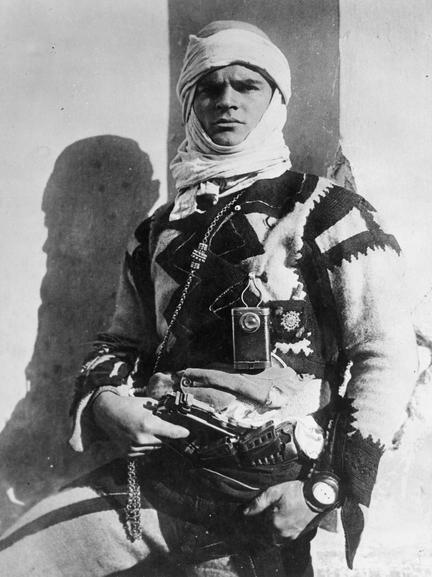
An Albanian volunteer in January 1916

Image

Debate about how the UK should commemorate World War I has been hotting up in the UK in recent days. On one side are those who suggest it was a ‘just’ war with Britain occupying the moral high ground. On the other are those who believe it was all the ghastly consequence of Imperialism and deranged dynastic power struggles.

One fact that shouldn’t be forgotten, however, is that the war was not confined to the Western Front. It spread from Africa, to Russia and across the oceans. One particularly forgotten area is the Balkans, where this Albanian soldier was photographed – looking rather more like a bandit than a regular soldier – in January, 1916.

His clothing and general demeanour can perhaps be explained by the fact he was a volunteer serving with the Albanische Legion, that had just been set up by the Austro-Hungarian army.

Photo: IWM Collections

Posted in Events | Tagged , , , , , , , , , | 3 Comments

Project to trace missing soldiers of World War I

Image

London’s National Army Museum has launched a campaign to identify forgotten casualties of World War I.

The Daily Telegraph reports the museum has established a dedicated unit to investigate cases where the deaths of soldiers, sailors and airmen from the conflict were inadvertently overlooked by the authorities.

Once each case has been verified, the name serviceman will be passed to the Commonwealth War Graves Commission (CWGC) to ensure it is added to a memorial.

Thousands forgotten

The project, which is due to run for two years, already has 360 names to research and is expecting considerably more to coincide with the Centenary of World War I.

Some experts believe there could be as many as 10,000 names missing from official records and memorials.

The newspaper mentions the case of 21-year-old lance corporal Peter Pollock of the Royal Irish Rifles, 21, killed on the first day of the Battle of the Somme on 1 July 1916. Amateur historians raised the case of the soldier and his name has recently been added to the Thiepval Memorial to the Missing in France.

David Bownes, assistant director of the National Army Museum, said: ‘Restoring honour to the casualties of the World Wars is a deserving enterprise and one that the National Army Museum’s experts are well-equipped to investigate and substantiate.’

Huge task

The CWGC was founded in 1917 as the Imperial War Graves Commission, but did not start its work until after the war had ended. Faced with a huge task it is perhaps not surprising that many soldiers were missed off the official lists, in particular those whose bodies were never found.

Others who were overlooked included some who died of wounds or illness back in the UK. Among these was 25-year-old bombardier Reginald Buckman, of the Royal Field Artillery.

A footman from Ardingly, Sussex, Buckman died of his injuries in hospital in London in October 1916, a month after being wounded on the Western Front. He now has an official headstone on his grave in Highbrook, West Sussex.

Posted in Events | Tagged , , , , , , , , , , , , , , | Leave a comment

A British Tommy recalls Christmas Truce of 1914

Image

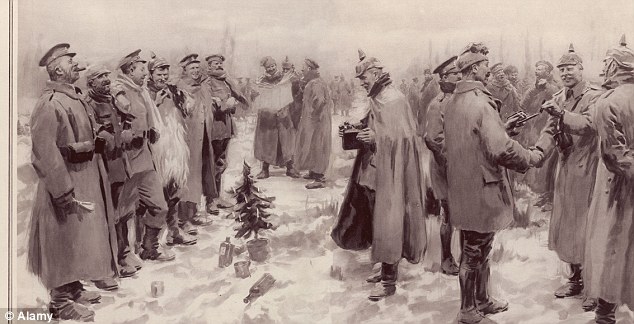
Sergeant Alfred Anderson is believed to have been the last survivor of the Christmas Truce. He was aged 18 on 24 December 1914 and serving as a private in the Black Watch on the Western Front.

Some 90 years later he recalled the moment when the German troops began singing Silent Night from their trenches: ‘I remember the silence, the eerie sound of silence. Only the guards were on duty. We all went outside the farm buildings and just stood listening. And, of course, thinking of people back home.

‘All I’d heard for two months in the trenches was the hissing, cracking and whining of bullets in flight, machine-gun fire and distant German voices.

‘But there was a dead silence that morning, right across the land as far as you could see. We shouted “Merry Christmas”, even though nobody felt merry. The silence ended early in the afternoon and the killing started again. It was a short peace in a terrible war.’

Posted in Events | Tagged , , , , , | Leave a comment

02

An editorial in British news periodical The Economist draws uncomfortable parallels between the world of today and that of 100 years ago.

As the Centenary of World War I approaches, the newspaper suggests that as 1913 came to a close most people in the West looked forward to the new year with a degree of optimism.

It reports: ‘John Maynard Keynes has a wonderful image of a Londoner of the time, “sipping his morning tea in bed” and ordering “the various products of the earth” to his door, much as he might today from Amazon – and regarding this state of affairs as “normal, certain and permanent, except in the direction of improvement.’

Darker parallels

More alarming similarities can be drawn between the nations of 1913 and those of today. The US can be compared to the UK – a superpower on the wane. Germany becomes China, a rising nation ‘bristling with nationalism’. France’s role goes to Japan, an ally of the declining superpower and of decreasing importance in its regional sphere.

Meanwhile, cautions the newspaper, business people turn a blind eye to the language of aggression and distrust in the quest for money and politicians whip up nationalist emotions for their own gains. Then there is a basket-case state in the shape of North Korea, capable of an act of madness.

The solution, suggests The Economist, may be a more active foreign policy from the US.

‘Unless America behaves as a leader and the guarantor of the world order,’ it adds, ‘it will be inviting regional powers to test their strength by bullying neighbouring countries.’

Posted on by DH | 1 Comment

Hobbit author JRR Tolkien’s WW1 revolver on show

Image

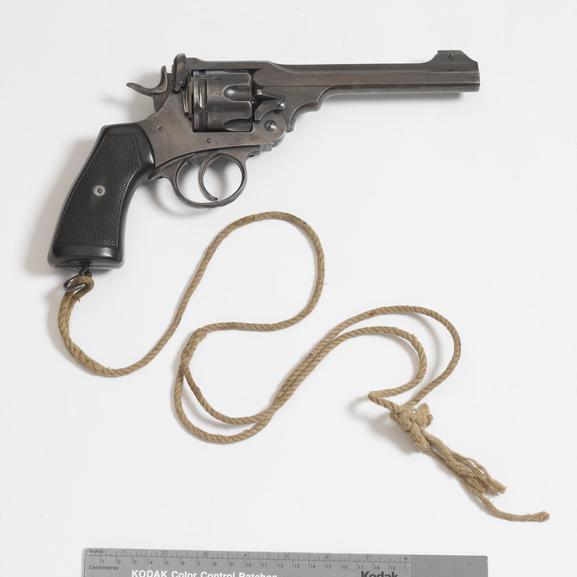
A revolver owned by scholar and writer JRR Tolkien during his World War I service has gone on show at Imperial War Museum North, in Manchester, as part of the preliminaries of its commemoration of the Centenary.

Tolkien served as a signals officer in the 11th Battalion, Lancashire Fusiliers from June to October 1916, when he became ill with trench fever and was sent back to the UK to recuperate.

While in hospital he began to formulate ideas that he would use in his books The Silmarillion, The Hobbit and The Lord of the Rings.

The weapon on show in Manchester is a Webley Mk VI, standard issue for British officers during World War I. In 1996, Tolkien’s family gave the gun to the Imperial War Museum.

Lasting effects

Effects of World War I Tolkien’s experiences on the Western Front shaped his later books, with episodes such as Frodo Baggins’ experience in the dead marshes in The Lord of the Rings, where he sees dead warriors in pools amid a desolate landscape, a reminder of the realities of the Somme and Ypres.

The writer also said that Sam Gamgee, Frodo’s dependable and heroic servant in The Lord of the Rings, was ‘a reflexion of the English soldier, of the privates and batmen I knew in the 1914 war, and recognised as so far superior to myself’.

The exhibition at the Imperial War Museum North coincides with the cinema recent release of The Hobbit: The Desolation of Smaug.

Graham Boxer, director of IWM North, said: ‘Visitors will be able to see this weapon and connect further with Tolkien’s magical stories which were born from harrowing wartime experiences.’ .

Posted in Events, News, Soldiers of the Great War | Tagged , , , , , , , , , , , , , , , | Leave a comment

Ypres painting on show at IWM North to mark Centenary

Image

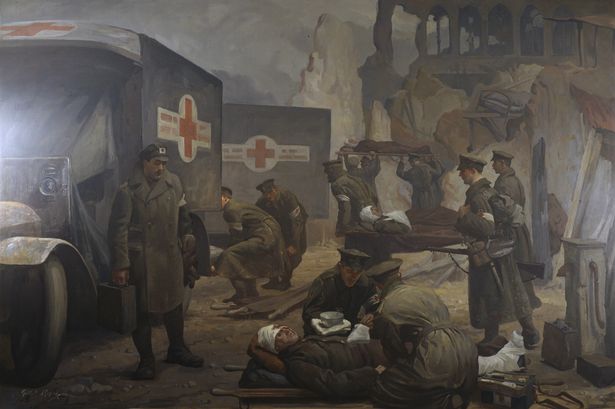
A painting depicting wounded soldiers at Ypres during World War I has gone on show for the first time in almost a century.

Ypres, 1915 by Gilbert Rogers is now on show at IWM North, part of Imperial War Museums, in Manchester. 

It illustrates the early work of the Royal Army Medical Corps (RAMC) and the British Red Cross Society (BRCS), who collected, transported and treated British soldiers wounded during the battles of Ypres in 1914 and 1915.

Rogers was the lead artist commissioned in 1918 to produce works for the medical section of the newly formed Imperial War Museum. This particular work is more than 11 feet high and 15 feet wide and was one of several large canvasses displayed in IWM’s first home at the Crystal Palace, south London.

The paintings suffered water damage from a leaky roof and remained rolled for many years until IWM was able to fund their restoration in the 1980s.

Ypres, 1915 is now on show outside the main exhibition space at IWM North.

Graham Boxer, Director of IWM North, said: ‘This stunning Rogers painting gives a reassuring image of quiet, well-ordered activity in Ypres, in contrast to the chaotic ruins in the background. This powerful image of ordinary people in extraordinary times is a fitting way to begin a major programme of exhibitions, displays and events marking the First World War Centenary.

‘The largest exhibition ever created exploring the role of the North West of England during the First World War – From Street To Trench: A War that Shaped a Region – will open on 5 April 2014.’

Posted in Events | Tagged , , , , , , , , , , , | Leave a comment

Book tells tale of World War I Hull gunners in Africa

Image

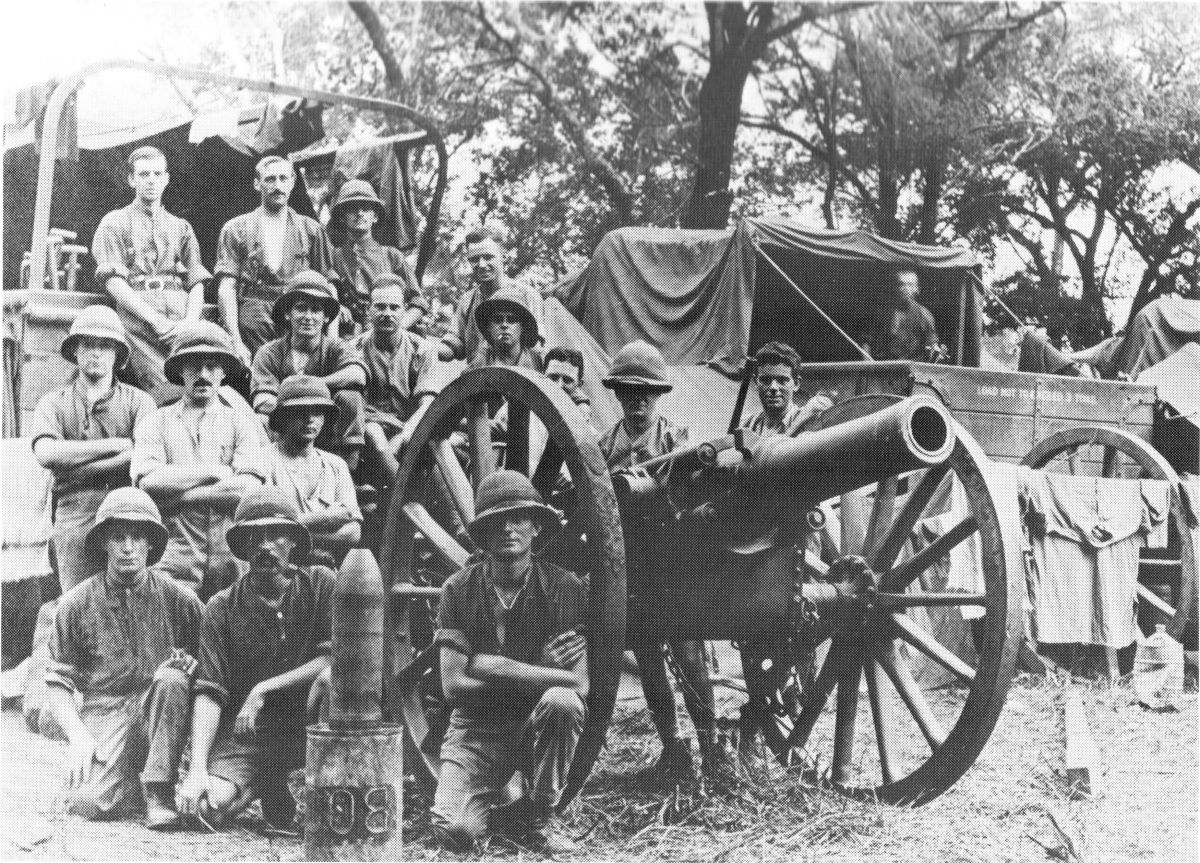
A new book tells the tale of a unit of the Hull Pals who served as artillerymen in Africa during World War I, reports the Hull Daily Mail.

Rupert Drake, whose grandfather Jack was one of those soldiers, has written a book called The Road To Lindi: Hull Boys In Africa.

Drake says: ‘My grandfather had a notebook with details about it but when he died, it was accidentally thrown away so I wasn’t sure whether I’d be able to find out any more.

‘When I started to look into the history of the unit, I found there is actually very little written about it. But I was determined to try to fill in some of the blanks.

‘Luckily, I was corresponding with some cousins in America and it turned out they had a photocopy of his notebook. That was my starting point.’

The Hull Heavy Battery fought in what is now Tanzania and Kenya. Disease was rife. Rupert estimates that in excess of one third of all troops in East Africa were permanently unfit for duty during the rainy season due to illness.

Jack Drake enlisted in Hull in December 1914. Due to his skill with horses, learnt living on a farm, he was posted to the 1st Hull Heavy Battery instead of to an infantry unit.

The Road To Lindi: Hull Boys In Africa is published by Reveille Press, priced £17.99. Visit reveillepress.westernfrontassociation.com

For the original Hull Daily Mail story, click here.

Posted in News, Soldiers of the Great War, World War I memoirs | Tagged , , , , , , , , , , | Leave a comment

Canadian War Museum secures VC medal of sergeant Herman Good

Herman_James_Good_VC

The Canadian War Museum has acquired a Victoria Cross awarded to sergeant Herman James Good on 8 August 1918.

He was one of four Canadian soldiers to be awarded the VC on the first day of the Amiens Offensive, a pivotal assault that ultimately led to the end of the First World War.

Sergeant Good survived the war and returned to his native New Brunswick, where he died in 1969 at the age of 80.

The Canadian War Museum now holds 34 of the 96 Victoria Crosses awarded to Canadians.

‘Medals such as sergeant Good’s VC help us tell the story of Canada’s role in the First World War,’ said James Whitham, director general of the Canadian War Museum.

‘As we approach the Centenary, it is more important than ever to continue telling their stories.’

On 8 August 1918, Sergeant Good, then a corporal, was part of the 13th Infantry Battalion, Canadian Expeditionary Force. His company pinned down by heavy fire and Good single-handedly attacked a German machine-gun nest, overwhelming the occupants and their three machine-guns. Later the same day, after encountering a German artillery battery, he led three men of his section successfully to capture the guns and their crews.

The Victoria Cross medal is part of a collection of items belonging to Sergeant Good, including his khaki field jacket and regimental Balmoral cap, an inscribed gold watch awarded to him by the town of Bathurst, New Brunswick, and photographs of Herman Good and his brother, Ernest Robert Good, who was killed in action on the Somme in 1916 and is commemorated on the Vimy Memorial to the Missing.

The medal was purchased with the assistance of the Museum’s National Collection Fund.

The Fund is supported by donors who help the Canadian Museum of Civilization and the Canadian War Museum acquire important artifacts of Canada’s cultural and military history that might otherwise be purchased by private collectors or museums outside Canada.

The Good VC will remain on display at the Museum until 5 January 2014.

Posted in News | Tagged , , , , , , , , , , , , , , , , | Leave a comment