Scottish rugby players killed in World War I remembered in Edinburgh

Image

Scottish international rugby players who were killed in World War I are to be honoured at an event in December at Edinburgh Central Library.

Scotland lost 30 international rugby players (including five captains) during the war – more than any other country. England lost 27 national team players, France 23, New Zealand 12, Wales 11, while Australia and Ireland both lost nine each.

During the event Alistair McEwen, project co-ordinator of Scotland’s War Project at Edinburgh University, will deliver an address based on a book published in 1919 that tells the story of the fallen players.

The book, The Rugby Roll of Honour, was written by sports journalist EHD Sewell, who described how the players took ‘their leadership, courage, teamwork, discipline and fitness’ from the field of play to the field of battle. The author had known many of the players which allowed him to give an insight into their personalities and background.

Among the players killed was Captain Thomas Arthur Nelson, who played in the centre in the 1898 Calcutta Cup in Edinburgh. He was a friend of the author John Buchan, who wrote: ‘He was the stuff of which adventurers are made.’

Captain Nelson, of the 1st Lothians and Border Horse and the Machine Gun Corps, was killed in action on 9 April 1917, aged 40, and is buried in Faubourg d’Amiens cemetery, Arras, France.

The first Scottish international rugby player killed was Lieutenant Ronald Simson of the Royal Field Artillery, who fell on 14 September 1914 on the Aisne. One of the last was Captain William Hutchison of the Royal Scots Fusiliers, who was killed during the German Spring Offensive of 1918 and is commemorated on the Arras Memorial.

Yvonne McEwen, historian and director of Scotland’s War Project, said while details of the rugby internationalists killed was available, research showed the accepted figure of between 90,000 and 150,000 Scots killed in the conflict was underestimated.

‘We have been systematically working through rolls of honour and found them incredibly deficient. A lot of names are not on them, there are those on them who are not Scottish, but classed as Scottish and lots of Scots not on them who should be.

A talk entitled Scottish Rugby Internationalists Who Fell in the Great War is on 11 December from 6:30-7:30pm at Edinburgh Central Library Conference Room. Free of charge. Booking essential. 

Posted in Events | Tagged , , , , , , , , , , , , , , , , , , | Leave a comment

Yorkshire man searches for rules of World War I card game

Image

A Yorkshire pensioner is trying to find anyone who knows the rules of Militaire, a card game that was played in the trenches of World War I.

The York Press reports that Brian Elsegood believes a deck of cards he owns originally belonged to his uncle, private Arthur Elsegood of 4th Battalion, Northumberland Fusiliers, who died in July 1918 at the age of 24.

The cards all have military ranks, and the game seems to have involved NCOs (such as lance corporals, corporals and sergeants) against officers (including second lieutenants, colonels and brigadiers).

The two different groups of cards are marked with the appropriate insignia of rank: stripes for the NCOs, epaulette badges for the officers.

Elsegood has attempted to find out how to play the game, but so far with no success. He has discovered, however, that it was played by soldiers during World War I.

Posted in Events | Tagged , , , , | 2 Comments

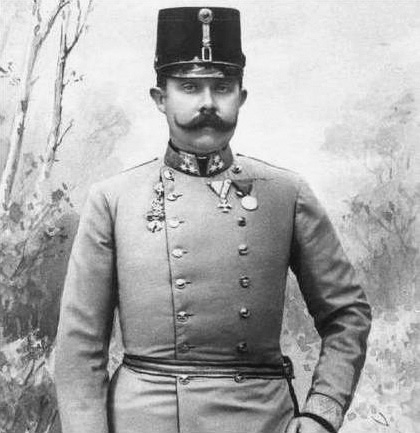
Franz Ferdinand accident could have changed course of history

Image

One hundred years ago, and just months before his death, Archduke Franz Ferdinand of Austria was nearly shot dead in a hunting accident in Nottinghamshire, England.

The BBC reports that at the time, the Duke of Portland – on whose estate the near-miss took place – later speculated the course of history could have been altered hugely if the accident had happened.

In November 1913 the Archduke and his wife Sophie, Duchess of Hohenberg, arrived at Welbeck Abbey, near Worksop, Nottinghamshire, after staying with King George V and Queen Mary at Windsor.

Large crowds cheered the Austro-Hungarian royals as they drove through the town of Worksop from the station. Waiting for them were a number of high-profile dignitaries; the Austro-Hungarian ambassador, the Duke and Duchess of Devonshire, Lord Curzon, the Marquis of Titchfield, Lord and Lady Salisbury and ex-Prime Minister Arthur Balfour.

Shortly afterwards Franz Ferdinand, the Duke of Portland and others went out to shoot pheasants. The Duke later recalled: ‘One of the loaders fell down. This caused both barrels of the gun he was carrying to be discharged, the shot passing within a few feet of the archduke and myself.

‘I have often wondered whether the Great War might not have been averted, or at least postponed, had the archduke met his death then and not at Sarajevo the following year.’

On 28 June 1914, during a visit to the Bosnian capital, Franz Ferdinand and Duchess Sophie were shot dead by nationalist Gavrilo Princip.

Had he died the previous year in England history could have been different, but the chances are the European powers would have found another reason to go to war.

The Worksop Library is hosting an archive display of photographs and newspaper cuttings about the Archduke’s visit and the local reaction to his death.

Posted in Events | Tagged , , , , , , , , , , , | Leave a comment

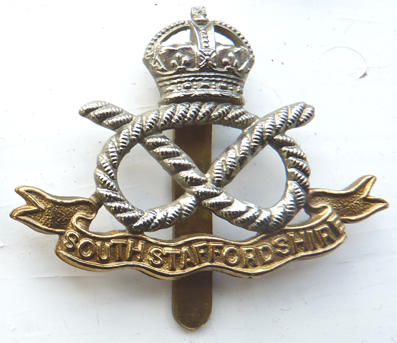
Medal of Staffordshire Regiment soldier found in Midlands garden

Image

A British gardening enthusiast has discovered two long-lost World War I medals in his potato patch.

Roger Aston, of Smethwick in the West Midlands, found one German and one British medal.

The latter was awarded to 33-year-old Private Francis Hubball, of the lst Battalion, South Staffordshire Regiment.

Private Hubball died in Flanders on 26 October 1917, during the third battle of Ypres. Prior to enlisting he had worked as a cycle polisher in Smethwick. He married his wife, Agnes, in 1907 and went on to have four children – Frances, Harold, Annie and Frank. They lived at 157 Dibble Road, Smethwick.

Aston is keen to find any surviving family members of private Hubball, but has encountered some problems.

‘His last name has also been spelt Hubble in some documents which make it difficult to track his relatives,’ he said. ‘I would love to be able to give the medals back to members of his family before next year’s Centenary.’

Aston thinks the medals may have been buried by local children playing in the area after World War I, but before his house was built in 1939.

‘I suspect private Hubball may have had more medals – whether they’re in the ground or with members of his family I don’t know.

‘I’ve no idea how the German medal ended up there, there are no identifying marks on it other than where it was made so that story ends there.’

Aston’s efforts to track down the soldier’s family have also so far proved fruitless. ‘The most recent record I can find is his youngest daughter married a man called William Henry Chance in 1954, but they disappear off the radar after that.’

Private Hubball is buried at Lijssenthoek Military Cemetery, Flanders – the second-largest Commonwealth cemetery in Belgium.

Posted in Events | Tagged , , , , , , , , , , , , | Leave a comment

World War I changed culture of mourning, says Yale professor

Langemarck

World War I changed the culture of mourning in Europe and acted as a crucial brake on progress, says Yale professor Jay Winter in an interview with Deutsche Welle.

Winter, who has curated the exhibition Missing Sons, at the Art and Exhibition Hall of the Federal Republic in Bonn, points out that many World War I soldiers simply vanished and that families often had no specific gravesite at which to mourn.

‘Half of those who died have left absolutely no trace,’ he told the newspaper, ‘they literally disappeared.’

Part of the reason for this was the effect of repeated artillery bombardments and the difficulties involved in removing the dead from No Man’s Land.

‘The notion of a ritual set of practices that had been in existence for centuries collapsed completely,’ added Winter. ‘In their place there were all kinds of unusual practices like spiritualism, like visiting séances to try to hear the voice of the dead to receive some kind of a message. These are indicators of what I would call a cultural crisis.’

‘I think the link between World War I and the present times is the cult of names. The names were the things that mattered. The names are all that mattered.

‘In war memorials you’ll see them, in churches… What matters is the list of the names in the parish or the town, the school or the university. It is the names. It is a way of bringing the bodies back home in a metaphorical sense of the term. Those names defined families that were empty, that had absences.’

Winter suggested also that the effect of World War I on European history has been far-reaching and remarkably negative.

‘Fundamentally, World War I was the moment when the first phase of globalisation was destroyed. Now we are in a second phase of globalisation and European reunification shows in some respects what might have happened had there been no World War I. Then 1914 happened, the economic crisis, the Nazis. It has taken us an entire century to get back to where we were in 1914.’

To read the original interview, click here.

Posted in Events, News, Soldiers of the Great War | Tagged , , , , , , , , , | Leave a comment

New Zealand WW1 commemoration plaque found in rubbish

Image

Waste disposal contractors in New Zealand have recovered a World War I memorial plaque amid a pile of rubbish.

The plaque commemorates private Ernest Wright, of 3rd Battalion, the New Zealand Rifle Brigade, who was killed in France on 23 November 1916.

Rob Wilson, operations manager at Burwood Resource Recovery Park, said that more than 40 tonnes per hour were being processed and it was sheer luck the 12 centimetre-wide penny was spotted intact.

‘Its value is not in its metal. Its value is in what it means to someone,’ he said. ‘This could’ve come from a commercial building as someone might’ve had it on their desk at work or maybe a residential house. It’s just so hard to tell.’

He added he would like to reunite the penny with its owner – presumably a relative of private Wright, who was born in Christchurch on 1 July 1887. The soldier was survived by his wife and their two children, Ella Kathleen Wright, born on 3 April 1913 and Gladys Evelyn Wright, born on 27 January 1914.

He is buried at Rue-David Military Cemetery, Fleurbaix – about 5km from Armentières.

If anyone has information that could help reunite Wright’s descendants with this penny contact rachel.young@press.co.nz.

Posted in Events | Tagged , , , , , , , , , , , , | 1 Comment

Lieutenant Gerald David Lomax, Welch Regiment

Image

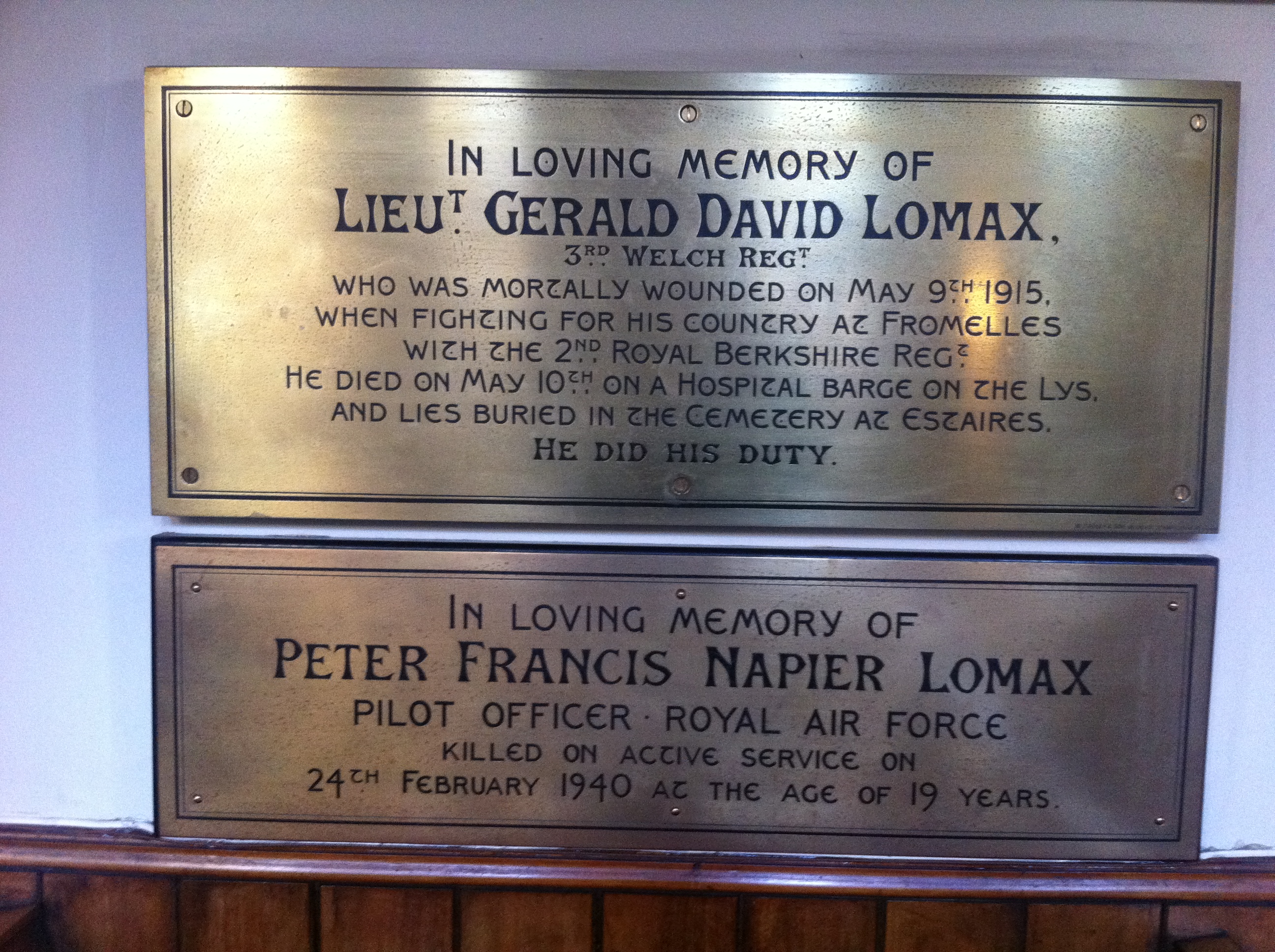
Second Lieutenant David Lomax is commemorated on a brass plaque at St Marylebone Church, London NW1.

It mentions that he was attached to the 2nd Battalion, Royal Berkshire Regiment, when he was mortally wounded at Fromelles in May 1915.

It also says he died ‘on a hospital barge on the Lys’.

Second lieutenant Lomax was born in Manorbier, Wales on 6 January, 1895. His father, Captain David Alexander Napier Lomax, was killed in action at Driefontain, South Africa on 10 March, 1900.

His mother, Annette, later married Major Frank Towle and they lived in the Marylebone area. Gerald was educated at Marlborough College – also the alma mater of his stepfather – and was gazetted into the 3rd Battalion, the Welsh Regiment on 15 August, 1914.

He played rugby for Rosslyn Park RFC and is mentioned in the recent book The Final Whistle, by Stephen Cooper.

A second plaque carries the name of his nephew, Peter Lomax, a Blenheim fighter-bomber pilot of the RAF’s 229 Squadron, who was killed in February 1940. To view his CWGC entry, click here.

Posted in Soldiers of the Great War | Tagged , , , , , , , , , , , , , , , , , , | Leave a comment

World War I medal found in Isle of Man field

Image

A metal detectorist is hoping to trace the relatives of a World War 1 soldier after discovering his Victory Medal in an Isle of Man field.

The BBC reports that the medal is embossed with the name WH Gelling and also mentions the Coldstream Guards.

Mark Leadley, who found the medal, said: ‘I am determined to reunite it with Mr Gelling’s relatives.’

Curator of social history for Manx national heritage Matthew Richardson added: ‘I believe the Isle of Man had the second highest percentage of male involvement of any county in the British Empire after New Zealand. No Manx family would have been untouched.’

Leadley found the medal in a farmer’s field in the south of the isle of Mann. ‘I knew immediately it was a medal as it had a clasp and I could see the figure. It was only when I got it home and cleaned it up that I realised it was a World War I medal – it was very exciting.’

If no relatives are found the medal will go on display in the Manx Military and Aviation museum.

To read the original story, click here.

Posted in Events | Tagged , , , , , , , | Leave a comment

Northampton soldiers honoured by local newspaper

Image

The Northampton Herald and Post has published a list of five famous World War I soldiers from the town.

Lieutenant Walter Tull was the first black officer in the British Army. From 1911-1914 he played 111 matches for Northampton Town FC and had previously played for Tottenham Hotspur.

In 1914 he joined the Middlesex Regiment and was later commissioned. He was killed on 25 March 1918 during the German offensive on the Western Front while leading a platoon of 23rd Battalion, Middlesex Regiment. He is commemorated on the Arras Memorial to the Missing.

Captain Anketell Read VC was an officer in the 1st Battalion, Northamptonshire Regiment and a former heavyweight boxing champion.

His VC citation reads: ‘On 25 September 1915 near Hulluch, France, Captain Read, although partially gassed, went out several times in order to rally parties of different units which were disorganised and retiring.

‘He led them back into the firing line and regardless of danger to himself, moved about under withering fire, encouraging them, but he was mortally wounded while carrying out this gallant work. He had shown conspicuous bravery on other occasions, particularly on the night of 29/30 July when he carried out of action an officer who was mortally wounded, under a hot fire of rifle and grenades.

Sergeant William Boulter VC, of 6th Battalion Northamptonshire Regiment, won his award in July 1916 at Trones Wood, France, when he destroyed an enemy machine gun nest. He survived the war and died in 1955.

Captain Thomas Colyer-Fergusson, of the the 2nd Battalion, Northamptonshire Regiment, was awarded the VC in July 1917, when he captured an enemy machine gun and captured numerous prisoners. He was killed by a sniper shortly afterwards.

Lance-Corporal Allan Lewis, 6th Battalion Northamptonshire Regiment, was awarded the VC on 18 September 1918 for destroying two enemy machine guns that were firing on his company. He was killed three days later.

His VC citation reads: ‘For most conspicuous bravery at Ronssoy on the 18th September, 1918, when in command of a section on the right of an attacking line held up by intense machine gun fire. L./Cpl. Lewis observing that two enemy machine guns were enfilading the line, crawled forward singlehanded, and successfully bombed the guns, and by rifle fire later caused the whole team to surrender, thereby enabling the line to advance.

‘On 21st September, 1918, he again displayed great powers of command, and, having rushed his company through the enemy barrage, was killed whilst getting his men under cover from heavy machine gun fire. Throughout he showed a splendid disregard of danger, and his leadership at a critical period was beyond all praise.’

Posted in Events | Tagged , , , , , , , , , , , , , , , , , | Leave a comment

Queen Victoria’s Rifles HQ, 56 Davies Street, London

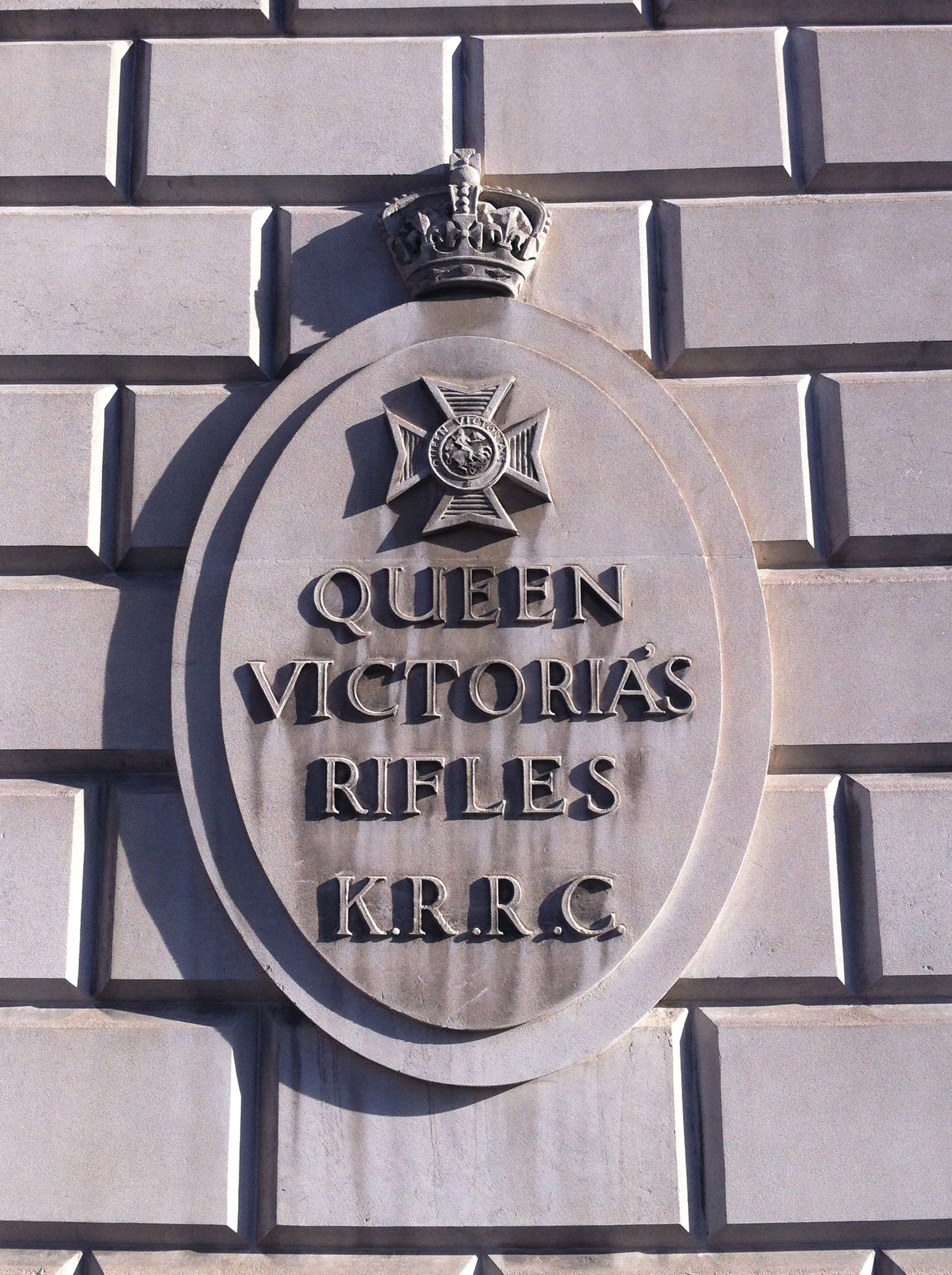
ImageThe badge of the Queen Victoria’s Rifles provides a reminder of World War I in one of London’s most well-heeled districts.

It adorns the wall of 56 Davies Street, where the unit (officially the 9th County of London Battalion) was based at the outbreak of war in 1914 and where it acontinued to have a presence throughout World War I and beyond.

The battalion landed at Le Havre on 5 November 1914 and was heavily engaged at Hill 60, Ypres, on 17 April 1915. Despite numerous casualties the unit repulsed a German counter attack and one of its officers, lieutenant Geoffrey Wooley, was awarded the Victoria Cross.

Wooley was the son of the Reverend George Wooley, the curate of St Matthew’s Church, Upper Clapton, Hackney. He had studied at Queen’s College, Oxford, and looked set for an ecclesiastical career before the war broke out.

His VC citation read: ‘For most conspicuous bravery on “Hill 60” during the night of 20th–21st April, 1915. Although the only officer on the hill at the time, and with very few men, he successfully resisted all attacks on his trench, and continued throwing bombs and encouraging his men until relieved. His trench during all this time was being heavily shelled and bombed and was subjected to heavy machine gun fire by the enemy.’

After the war Wooley resumed his theology studies at Oxford and later worked as a parish priest and as the chaplain of Harrow School. He rejoined the army in World War II and served as a major in the Royal Army Chaplains’ Department.

For film footage showing men of the Queen Victoria’s Rifles in 1914, click here.

Posted in News, Soldiers of the Great War | Tagged , , , , , , , , , , , , , , , , , | 6 Comments