

An amateur historian has researched the lives and war records of hundreds of Yorkshire and Derbyshire men who fought and died in two world wars.
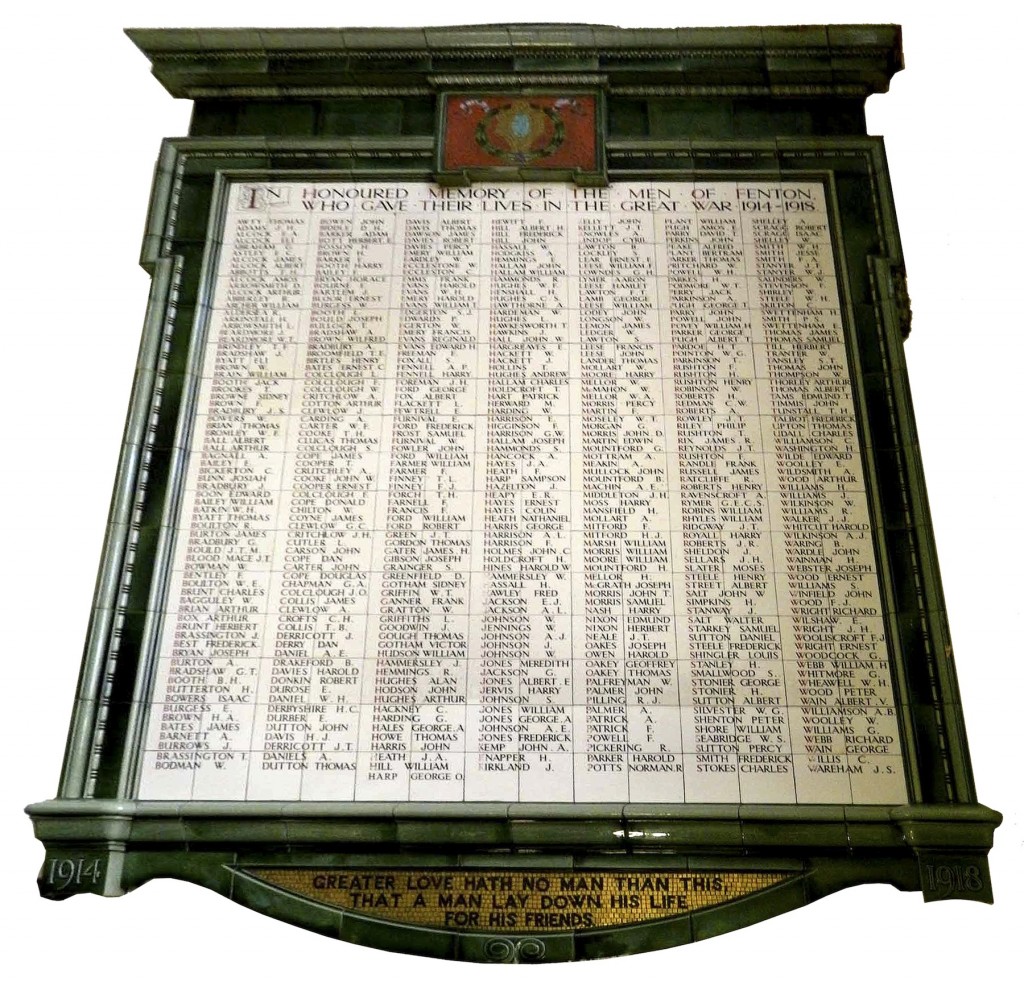
The Sheffield Star reports how 45-year-old accountant Simon Goodwin has spent the past four years on a quest to identify more than 500 men named on local war memorials.
Goodwin, a member of the Western Front Association, told the newspaper: ‘I had been to a previous Remembrance service in Eckington Church and was surprised at how many times only initials and not first names were known and read out for the casualties. From there, I just got carried away.’
So far, Goodwin has managed to find out details of almost 400 of the Eckington Parish soldiers, but research on a further 120 is still to be completed.
He said: ‘I have now completed looking for information in all the most obvious places. I would be interested to hear from anyone else who comes forward with more information or photographs of any of the men.’
Among those about whom Goodwin has discovered details is private Alfred Harris of the Sherwood Foresters, who was given the Distinguished Conduct Medal and died in 1917 aged 31. He is buried at Mendingham Military Cemetery, Belgium.
He also discovered that one soldier, private Alfred Haddock, of 12th Battalion York and Lancaster Regiment, was executed for desertion on 16 September 1916, aged 32, and is buried at Vielle-Chapelle New Military Cemetery, France.
Private Haddock was a former regular soldier who had been recalled to the colours in 1914. He went missing on 30 June 1916, as his battalion was moving up to the line to take part in the first day of the Somme offensive. He was apprehended by the military police five days later, without rifle and equipment, and hiding in a civilian wagon.
Since arriving in France in September 1914, private Haddock had deserted seven occasions and was already facing a lengthy suspended sentence went he went missing for the final time.
Another reason why he was unlikely to have received clemency was the fate of his battalion in the days after he deserted. It lost 513 officers and men killed, wounded or missing between 1 and 3 July 1916, largely in the attack on the fortified village of Serre.
Simon Goodwin can be contacted at eckingtonwarmemorial@gmail.com.




 First World War Centenary, 1914-1918
George Grosz exhibition in London
London gallery Richard Nagy is running a major exhibition dedicated to the work of George Grosz (1893-1959).
Some 50 works by the German satirical artist and World War I veteran have been assembled from leading private and public collections around the world.
The works in this exhibition typify Grosz’s distrust and dislike of many aspects of bourgeois life in Germany in the inter-war period. His depiction of military generals in works such as Vor der Kaserne (In front of the Barracks) (1918) also shows his hatred of German militarism and its consequences for the ordinary citizen.
Grosz was fascinated by cosmopolitan Berlin in the 1920s and his works depict a grim, often nightmarish world of crime, murder and sensuality.
Another frequent aspect of his work are the crippled veterans of World War I who, lacking legs, arms or noses, often appear in the background – generally reduced to begging or unemployment.
One highlight of the exhibition is an important work that was recently discovered in a private collection and has never been shown outside Germany. It is an earlier, watercolour version of an oil painting entitled Deutschland, Ein Wintermärchen (Germany, a Winter’s Tale) (1918), which was probably destroyed in the early 1930s.
In the centre of the image a plump bourgeois nationalist sits at a dinner table with knife and fork at the ready. Around him brothels, factories and tenement buildings can be seen, while establishment figures from banking, church and army lurk in the background, hoping to profit from the sufferings of others.
The Richard Nagy show will benefit Global Witness, a not-for-profit organisation dedicated to protecting communities and their environments from the abuses that result from natural resource-related conflict and corruption.
Patrick Alley, director of Global Witness, said: ‘We are delighted that Global Witness will share a platform with this fascinating and timely George Grosz exhibition. Being so savagely critical of corruption and injustice, his work resonates strongly with our campaigns to tackle the international systems, and political, financial and economic norms which exacerbate these problems.’
The exhibition runs until 2 November.
To find out more about Global Witness, click here
Share this: