Cambridge lone piper to mark anniversary of WW1

War Memorial, Cambridge

Cambridge will mark the outbreak of the First World War with a lone piper playing a lament from the balcony of the city’s Guildhall.

The city’s mayor, Cllr Gerri Bird, and the vice-chancellor of Cambridge University, Professor Sir Leszek Borysiewicz, will also light candles in the window of the Guildhall during the ceremony, which will take place at 10pm on Monday, 4 August.

Earlier in the evening, at 6pm, a special service will be held at Great St Mary’s Church in Cambridge.

Posted in Events, News | Leave a comment

Exhibition focuses on Staffordshire Regiments in WW1

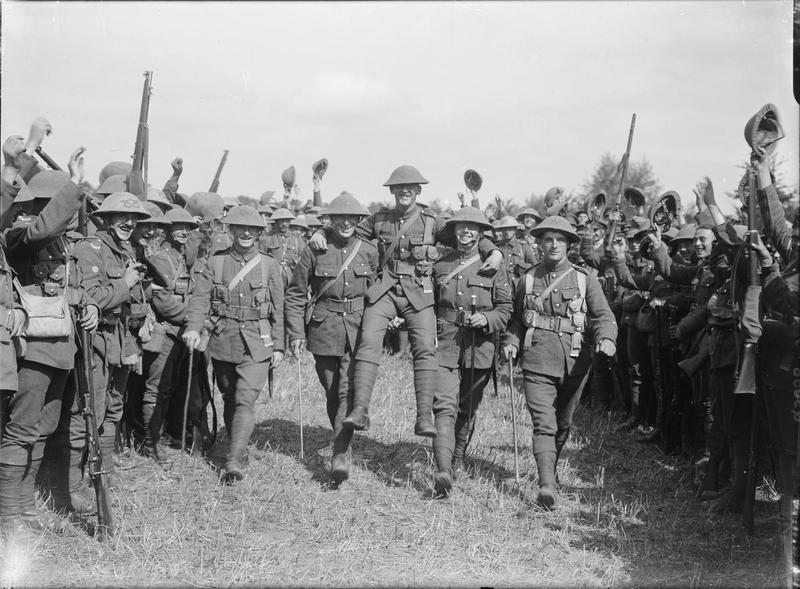
Staffordshire Regiment at Cassel

An exhibition focusing on Staffordshire soldiers of the First World War has opened in Lichfield.

Entitled Staffordshire Goes to War the display will be hosted by the Staffordshire Regiment Museum using some items from the National Army Museum (NAM).

The North Staffordshire and South Staffordshire regiments were involved in many theatres of the First World War and fought at some of its most lethal battles.

Figures from the First Battle of Ypres in 1914 show that 93 per cent of those serving with the 1st Battalion of the South Staffordshire Regiment were killed or wounded.

Janice Murray, director general at the NAM, said: ‘We were delighted to work with the Staffordshire Regiment Museum to create this unique exhibition, and are looking forward to opening its doors to visitors.’

Staffordshire Goes to War runs until 18 January 2015.

Posted in Events, News | Leave a comment

Search solves mystery of WW1 officer painting

_76343588_76338597

An unknown World War I officer, depicted in a painting, has been identified by the website Art Detective.

The picture was in the collection of Carmarthenshire Museums in Wales. It depicts Second Lieutenant Paul Chancourt Girardot of the 2nd Battalion, Oxford & Buckinghamshire Light Infantry, whose mother lived at Carmarthen.

Girardot was an only child who had lost his father aged just seven. He had been educated at Cheltenham College before joining the army in early 1914.

He was killed in an an artillery bombardment, alongside many of his platoon, on 16 September 1914 at Soupir in France.

The battalion had lost two other officers the previous day; 22-year-old lieutenant Hugh Mockler-Ferryman, from Tavistock, Devon, and 27-year-old lieutenant Reginald Worthington of Kidmore, Oxfordshire. 


Posted in News, Soldiers of the Great War | Leave a comment

Serbian leaders to attend Princip statue unveiling

Image

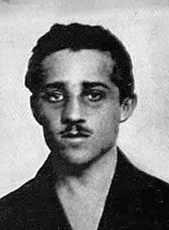
The Serbian prime minister and president are to attend a ceremony in Sarajevo to unveil a statue of Gavrilo Princip, the young student who assassinated the Austro-Hungarian Archduke Franz Ferdinand.

The shooting, on 28 June 1914, provided the spark that led to the First World War.

Princip was a Serb nationalist who thought Bosnia and Serbia should be unified outside the Austro-Hungarian empire. Concerts in two Bosnian cities will also mark the 100th anniversary of the Sarajevo assassination.

Posted in Events | Tagged , , , , , , , , , , , | Leave a comment

British Library opens WW1 Centenary exhibition

G70109-93

The British Library is marking the Centenary of the outbreak of the First World War with an exhibition entitled: Enduring War: Grief, Grit and Humour. On show are Christmas cards, letters, cartoons, posters and the manuscripts of famous war poets.

Writers’ letters

The exhibition considers themes such as humour, faith, comradeship and family. Key items in the exhibition include a letter from Sir Arthur Conan Doyle to his mother describing his worries about his son serving at the Front, written in the light of his belief in Spiritualism. Also included in the show is a letter from Isaac Rosenberg and the manuscripts of well-known war poets, such as Rupert Brooke.

The concept of humour in adversity is explored through a selection of caricatures, cartoons, humorous Christmas cards, a romance novel set in a munitions factory and trench journals.

In a poignant conclusion the exhibition explores the grief expressed over the millions of lives lost during the First World War. A soldier’s last letter home as he goes into battle is on display for the first time alongside manuscripts of Wilfred Owen’s Anthem for Doomed Youth, Vaughan Williams’ A Pastoral Symphony and Laurence Binyon’s For the Fallen.

Record of the Indian army in Europe during the First World War [Girdwood Collection]. Photo 24 (294)

Personal experiences

Dr Matthew Shaw, co-curator of Enduring War, said: ‘It has been a privilege to make this selection of First World War material from the library’s great collections, which reveals something of the personal experience of that conflict, the echoes of which are still with us today.’

Alison Bailey, co-curator of the exhibition, added:’The exhibition brings together material that has come to have national significance, such as the manuscripts of now famous war poets, with less familiar items like Christmas cards and concert programmes that people might not expect to find in the British Library’s collection.’

Enduring War: Grief, Grit and Humour runs until 12 October 2014. For more about the exhibition, click here.

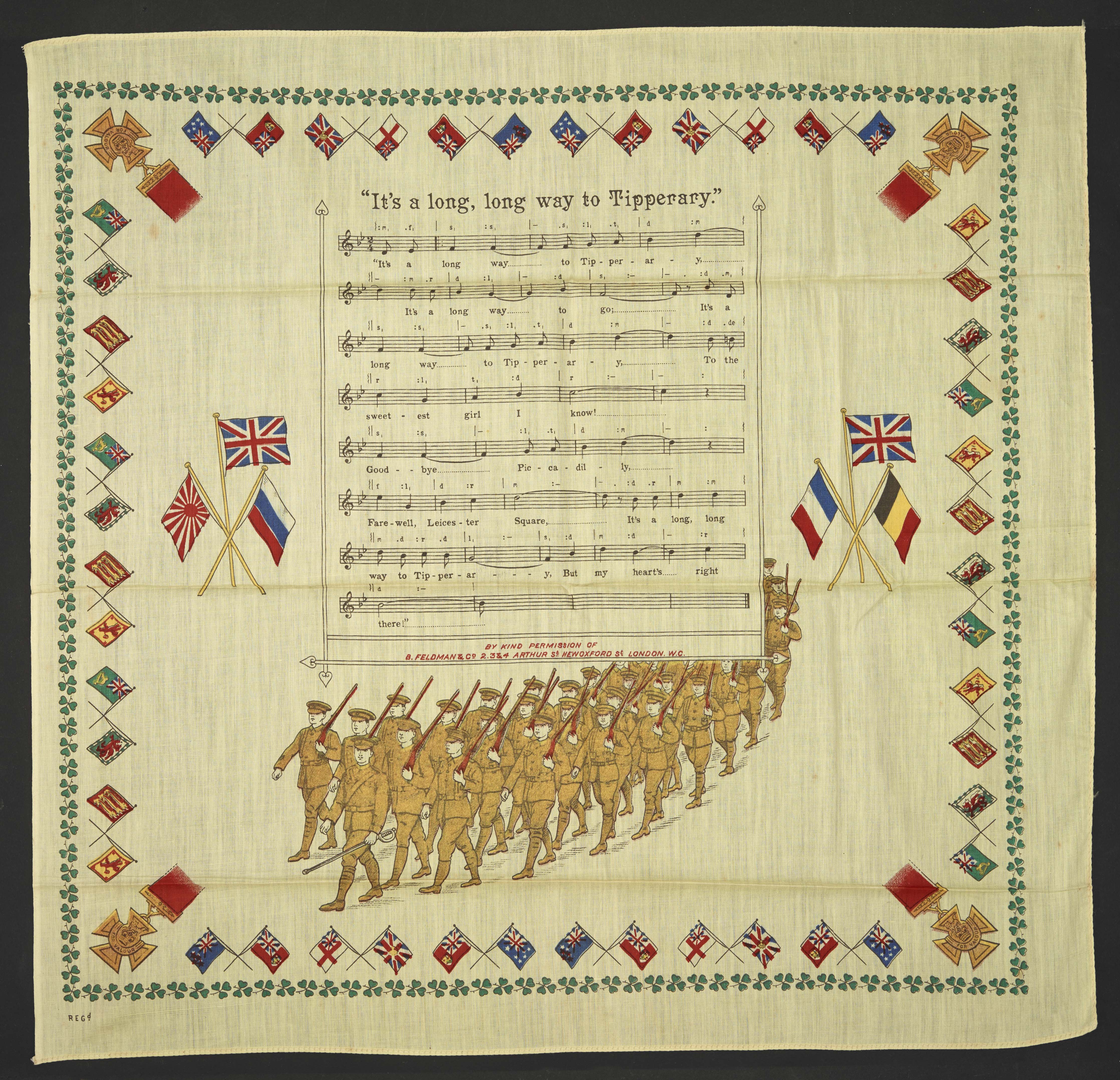
Tipperary handkerchief

Posted in Events, News | Tagged , , , , , , , | Leave a comment

Devon village remembers tallest British soldier of WW1

Image

A soldier who was reputed to be the tallest man in the British Army during the First World War will be remembered in Devon later this month as part of commemorations of the Centenary.

Harry Barter stood more than 6ft 9in and served with the Grenadier Guards during the First World War. He was wounded in action at the First Battle of Ypres and was later transferred to the Labour Corps.

He would later tell family members about having to remember to duck to avoid snipers when in the front line trenches. He died in 1926, partly as a result of wounds sustained in Belgium.

Memorial concert

On Sunday 29 July a concert will be held at Littlehempston church to remember Grenadier Barter and the 31 other village men who served in the war. Of these, six were killed.

Among them was lieutenant Wymond Pole Carew of the Duke of Cornwall’s Light Infantry, who was killed near Ypres in November 1917. Educated at Marlborough College, Pole Carew had been ADC to the Governer of Bombay and had won the Gold Medal at Sandhurst Military College in 1916.

Also remembered on the memorial is 19-year-old second lieutenant William Ricketts of the Leinster Regiment and trumpeter Sidney Smerdon of the Royal North Devon Hussars, who died in Egypt in 1915.

Tickets for the concert can be purchased from the Totnes Information Centre.

Posted in Events, News, Soldiers of the Great War | Tagged , , , , , , , , , , , , , | Leave a comment

English WW1 Muslim Cemetery to be restored

Image

A memorial to Muslim soldiers who died during the First World War is to be restored to mark the Centenary.

The former cemetery, at Horsell Common near Woking, has been repaired following a grant from English Heritage. Originally built in 1915 the area was designed to be the last resting place for Muslim soldiers of the Indian army. However, the remains were later transferred to the Brookwood Cemetery.

Class system

The men’s names are still recorded at Horsell and they hint at the caste-defined society that still exists in India and Pakistan. Among the likes of Alla Ditta Khan of the 15th Lancers and Mirza Iqbal Ali Beg of the Royal Military College are lower-caste men referred to just by one name: Abdullah, Babu or Hanza.

The UK’s Secretary of State for Culture, Sajid Javid, said: ‘Over one million troops from pre-partition India fought as members of the British Armed Forces in the First World War, many of them Muslim.

‘Now standing as a symbol of those lost, and an early and important part of British Muslim history, the restoration of the Muslim Burial Ground to its former glory is particularly poignant in the year we remember the outbreak of the First World War.’

Islamic peace garden

Woking Borough Council plans to create a peace garden within the walled burial ground. Councilor John Kingsbury, leader of Woking Borough Council, said: ‘We are delighted to have obtained this important funding to enable us to complete the final phase of this project. The Muslim Burial Ground is an important heritage site, both locally and nationally.’

The idea is to create what the council refers to as an, ‘Islamic-style peace garden’. This will contain 27 Himalayan Birch trees planted to symbolise the men who were once buried here. Pink and white heather will be planted in strips, pointing towards Mecca.

Posted in News, Soldiers of the Great War | Tagged , , , , , , , , , , , , , | Leave a comment

Archeology project explores Yorkshire First World War trenches

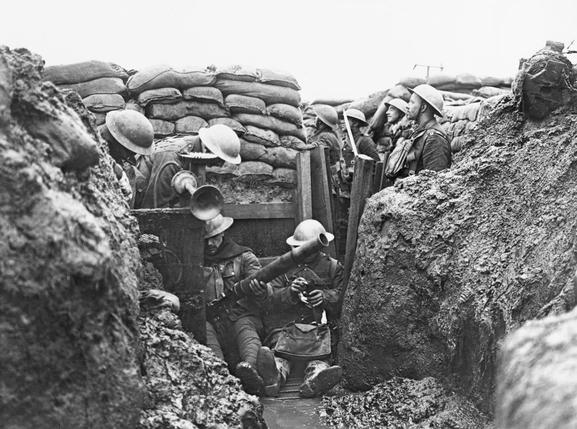
Trench

A community archaeology project supported by the Yorkshire Dales National Park Authority (YDNPA) is looking to uncover a forgotten aspect of the First World War.

Members of the local community are being invited to help shed some light on three military training sites in the Settle area.

Among them are two possible trenches within the grounds of the Giggleswick School estate. These may have been used to give soldiers some insight into what they would face on the Western Front.

Training and Trenches

The Training and Trenches project has been awarded £7,000 from the Heritage Lottery Fund and excavation of the suspected training trenches will take place from 18-23 June.

James Spry, the YDNPA’s Community Archaeology Training Placement Holder and Project Manager, said: ‘The project will involve documentary research, a survey of the Castleberg Drill Hall in Settle and a firing range at the base of Attermire Scar, and the excavation.

‘The drill hall and the firing range were used by members of the Craven Territorials, later the 1/6th Battalion of the Duke of Wellington’s (West Riding) Regiment, the Village Guard and the Giggleswick School Officer Training Corps.

Officer Training Corps

‘The trenches may have even been dug by members of the school’s Officer Training Corps, either before or during the war. If the excavation and further research reveals this to be the case, it will be a poignant story as many of those schoolboy officers went on to fight and die in the war and are commemorated in the school’s chapel.

‘The aim of the project is to look at the physical legacy of the First World War in Britain rather than in Europe, where the battles were fought. We also want to try to find out more about the beginnings of trench warfare.

‘We are hoping that people will contact the National Park Authority perhaps with memories of family members who were involved in the three sites or with letters, records or photographs that can shed light on their history.’

Posted in News | Tagged , , , , , , , , , | Leave a comment

The Lincolnshire regiment at Leighton Buzzard

Image

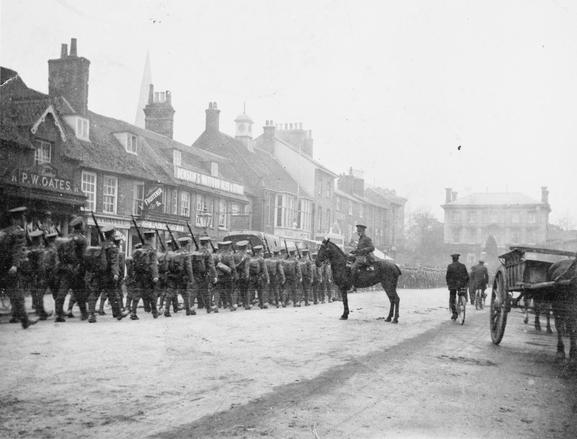
Major John Storer (on horseback) observes the 8th Battalion, Lincolnshire Regiment, marching through Leighton Buzzard, Bedfordshire. Formed in September 1914, the battalion trained in Hertfordshire and Bedfordshire in the winter of 1914-1915, when this photograph was taken.

The Battalion landed at Boulogne on 10 September 1915.

Major Storer was killed a few weeks later, on 25 September, at the Battle of Loos. His name can be found on the Loos Memorial to the Missing. The inexperienced battalion lost 22 out of its 24 officers at Loos, while 471 other ranks were reported as killed, wounded or missing. Commanding officer lieutenant colonel Harold Walter was among the casualties.

Posted in News, Soldiers of the Great War | Tagged , , , , , , | 7 Comments

German WW1 heroine remembered in TV drama

Image

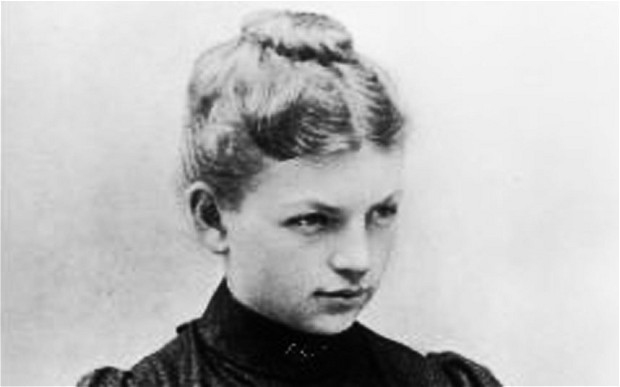
A German TV show is focusing on Clara Immerwahr, the first German woman to be awarded a doctorate in chemistry.

She and her husband, Fritz Haber, invented the process by which ammonia is produced to this day.

Poison gas

During the First World War, Haber turned his attention to developing poison gas, unleashing the first weapon of mass destruction. Immerwahr was appalled at this development and committed suicide, shooting herself in the chest with her husband’s military pistol. Her death was then hushed up.

The lavish TV drama, entitled Clara Immerwahr, focuses on the innovative woman’s work at a time when the highest level a female could reach in a chemistry context was lab assistant.

Immerwahr begged Haber to stop his work on chemical weapons, and denounced it as a ‘perversion of the ideals of science’. He denounced her as a traitor in response.

Immerwahr and Haber were both Jewish converts to Christianity. When the Nazis came to power Haber was forced to flee Germany.

To watch the film, click here.

Posted in News | Tagged , , , , , , , | Leave a comment