British MOD attempts to identify soldier found on battlefield

Image

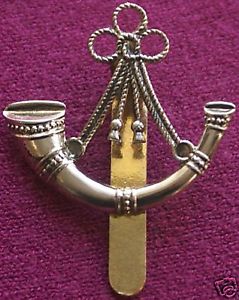
The living relatives of a World War I soldier whose remains were discovered in northern France are being sought by the Ministry of Defence (MoD). The body was found in a garden near Beaurains in June 2012. It is thought to be one of four officers from the Oxford and Buckinghamshire Light Infantry who died on 3 May 1917 and are commemorated on the Arras Memorial.

Four missing officers

It is believed to be either William Haynes or Charles Harper from Buckinghamshire, Stanley Ashman from Weston-super-Mare or John Bulmer from Yorkshire.

Lieutenant Stanley Ashman was the son of Alfred and Annie Ashman of South Field, Radstock and had five brothers.

John Legge Bulmer was a 22-year-old second lieutenant in the 4th Battalion attached to the 5th Battalion. The son of the Rev Edward and Elizabeth Bulmer of Brooklands, Filey, he had four brothers and a sister. He was head boy of Marlborough College in 1913 and later studied at Merton College, Oxford where he knew TS Elliot.

Charles Croke Harper was a second lieutenant in the 3rd Battalion attached to 5th Battalion. Born in 1880, he was the son of the Rev EJ and Frances Wetherall Harper of Broughton Rectory, Newport Pagnell, and had two brothers, Francis and Lionel and four sisters, Margaret, Mabel, Constance and Grace.

William Charles Haynes, from Aylesbury, was also a second lieutenant, who served with D Company, 5th Battalion Ox and Bucks Light Infantry. He was born in 1889, the son of licensed victualler Henry Haynes and his wife Elizabeth and had two brothers, Horace and James, and three sisters, Agnes, Florence and Connie.

He worked at the Dominion Dairy Company in the town before joining the Buckinghamshire Yeomanry and was commissioned into the Oxford and Buckinghamshire Light Infantry in January 1917.

Posted in Events | Tagged , , , , , , , | Leave a comment

British National Archives digitises World War I diaries

Image

Britain’s National Archives has begun to digitise the more than 1.5 million pages of World War I diaries in its collection.

Most of this comprises official diaries, recording the day-to-day activities of British army units during the war.

They include descriptions of marches, parades, billets and sporting events, says historian William Spencer.

‘It’s usually soccer,’ he adds. ‘So for example, the first day of the Battle of the Somme, the first of July 1916, at least one regiment is known to have advanced towards the enemy kicking a football.’

‘If you want to get your people pointing in the right direction, you kick a football over the top, and they followed it.’

Caroline James, an amateur historian who recently began working at the archive, discovered a diary record related to one of here relatives, private Charles Alfred Hunt of the 12th (Prince of Wales Royal) Lancers.

The experience changed her perception of the war, she says. ‘You think, those were real men. They had mums, they had brothers and sisters and girlfriends and wives and children.’

The 12th Lancers’ war diary entry for the day private Hunt went missing in terse and to the point.

‘After a tiring march at 11:30 PM, B squadron captured a German car,’ the passage reads. ‘Casualties: 2nd Lt RFT Moore and 11 men missing.’

The Archive have also launched Operation War Diary, which involves the recruitment of what it terms ‘citizen historians’ to crowdsource the research into the documents.

To find out more, click here.

Posted in Events | Tagged , , , , , , , , | Leave a comment

British World War I conscription appeals go online

exemption-cert-238x299

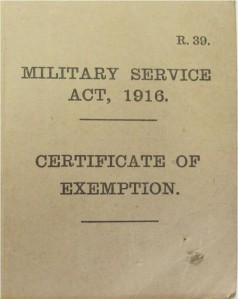
The digitised records of over 8,000 Britons would sought exemption from conscription into the army in the county of Middlesex during World War I have been made available online by the UK’s National Archives.

The conscription appeal records are from the Middlesex Appeal Tribunal that, between 1916 and 1918, heard appeals from men who had applied for exemption from compulsory military service. The records include case papers of thousands of individuals, as well as administrative papers reflecting the changing policy towards conscription as the war progressed.

The collection is one of only two complete surviving collections of tribunal records and provides compelling insights into the impact of World War I on families, businesses and communities far from the battlefields.

Economic reasons

Chris Barnes, records specialist at the National Archives said: ‘The conscription appeal records provide a different perspective of the World War I away from the battles, revealing the impact the war had on the Home Front. Digitising this collection opens up the records to allow people across the globe to discover the lesser known stories of First World War for themselves.’

Of the 11,307 separate appeals heard between 1916 and 1918, only 577 were conscientious objection cases. The vast majority focused on medical, family or economic grounds. Most were dismissed.

John Gordon Shallis

Shallis appealed on grounds of domestic hardship, having lost four of his brothers during the war. His mother is described as a ‘cripple’ on his appeal form, having broken her leg, and his father was away carrying out Home Defence duties with the Territorial Force.

CWGC lists his brother Charles, a Royal Navy stoker on HMS Defence who died at the Battle of Jutland, here. George, an assistant stoker on the armed merchant cruiser HMS Viknor, is listed here. His brother Albert was a private in the Royal Fusiliers and Harry was a rifleman in the King’s Royal Rifle Corps.

Given these exceptional personal circumstances and his employment within the munitions industry, Shallis was granted an exemption from compulsory military service.

Charles Rubens Busby

An anonymous letter from a local resident, sent directly to the Middlesex Appeal Tribunal, is attached to Busby’s case paper.

The letter questions why Busby is allowed to keep his butcher’s shop and not serve while ‘married men have had to shut up their shop and go’. Busby is described as ‘a proper rotter of a man’ and a ‘rotten shirker’. He later served with the Royal Navy and Royal Air Force between 1917 and 1918.

Harry George Ward

Ward appealed on conscientious grounds based on his socialist beliefs. The tribunal chairman allegedly stated that as a socialist he could not possibly have a conscience. Ward’s appeal was dismissed.

Aden Stone

Stone was a butcher who appealed on economic grounds in order to look after his shop. An exemption was granted by the tribunal, but it was only for one day. This was because the tribunal decided that Stone had deliberately brought out a local competitor in an attempt to increase his business needs and thus improve his chances of exemption.

Posted in Events | Tagged , , , , , , , , , , , , , | Leave a comment

Real World War I casualty figures may be much higher, says historians

Image

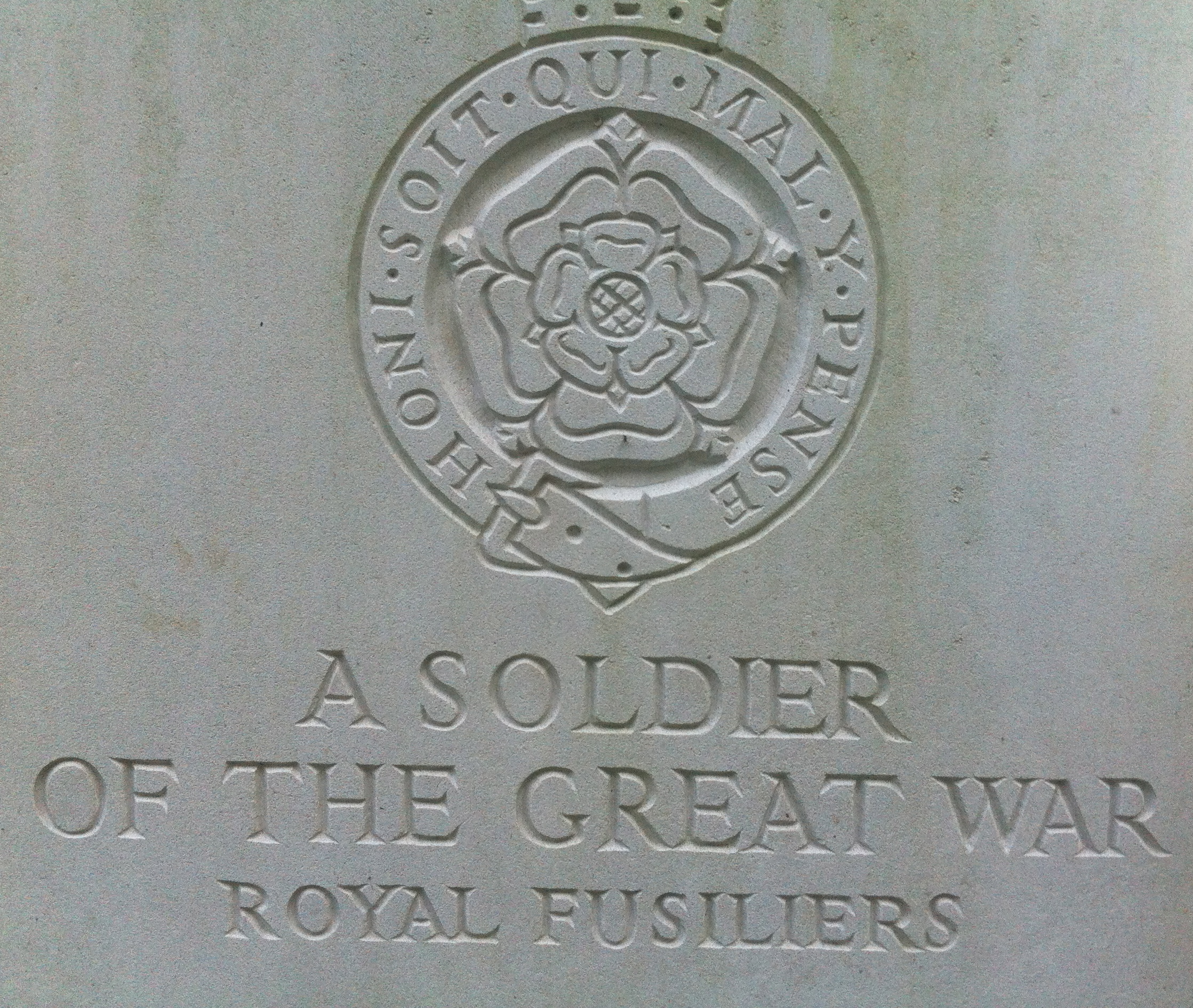
A gravestone in Belgium belonging to an unknown Royal Fusilier

More soldiers may have died in World War I than official records show and the numbers of veterans suffering shell shock was also hugely underestimated, suggest two leading historians.

Antoine Prost, professor of history at the University of Paris, says that post war governments across Europe produced conservative casualty figures, partly because of clerical errors and partly to stem anger among the general public.

Missing soldiers

Professor Prost’s claims are made in The Complete Cambridge History of the First World War.

‘The calculation of losses isn’t easy and most studies present lists of figures without explaining what they cover or how they have been established,’ he told The Times newspaper in London.

‘There is confusion concerning places whose borders had shifted; there is inconsistency in recording the deaths of soldiers from sickness and prisoners of war who died in captivity; and there is uncertainty surrounding the number of soldiers reported missing. It seems that in several cases, including Britain, the generally accepted calculations are underestimates.’

Shell-shock ignored

The book’s editor, professor Jay Winter of Yale University, adds that the scale of shell-shock was also misrepresented. He suggests that as many as one in five injured British soldiers suffered with mental health problems.

‘Medical and administrative practices and prejudice led to radical underestimates of shell shock. ‘Studies show stress in the Great War was probably more intense than in later conflicts and yet physicians were reluctant to diagnose many injuries as psychological.

‘To do so probably would have made it less likely [he] would receive a pension.’

PTSD undiagnosed

In addition huge numbers of soldiers would have been suffering from what would now be termed post-traumatic stress disorder. In an era when men were encouraged not to complain and to ‘just get on with it’, such issues went undiagnosed and unmentioned.

However, the trauma experienced in World War I continued to live with many veterans, otherwise unharmed, for their entire lives and had considerable, if hard to quantify, effects on their families.

Posted in News, Soldiers of the Great War | Tagged , , , , , , , | Leave a comment

Medal lost for 40 years appears on auction site

Image

A man has discovered a missing World War I Victory medal on auction site Ebay 40 years after it disappeared.

Terry Snow, from Devon, accidentally lost track of the medal during a house move and has since searched for it in antique shops and online in the hope that it might one day surface.

On his birthday, Saturday, January 4, he finally spotted the missing medal online where it was being sold by a collector from Lincoln.

War memories

Terry’s father, Gilbert Snow, served as a Lewis gunner in the Middlesex Regiment. Like many veterans of World War I he did not often mention his experiences, but his son does at least recall one episode.

‘On one occasion being at the end of the line, he turned around to notice all of his mates had gone. He then ran down a road and the Germans got behind him and as he was running with the Lewis Gun on his back, he had bullets spraying all around him, but he chucked it on the floor so he could run faster.

‘But one of the bullets actually shattered the gun across his shoulder and another went straight through his trousers.

‘I have actually been to take photographs of one of these roads he went down – there are still live shells there to this day from 100 years ago.’

Private Gilbert Snow’s British War Medal is still missing and his son remains hopeful of recovering it.

Posted in Events | Tagged , , , , , | Leave a comment

West London call for World War I memorabilia

Image

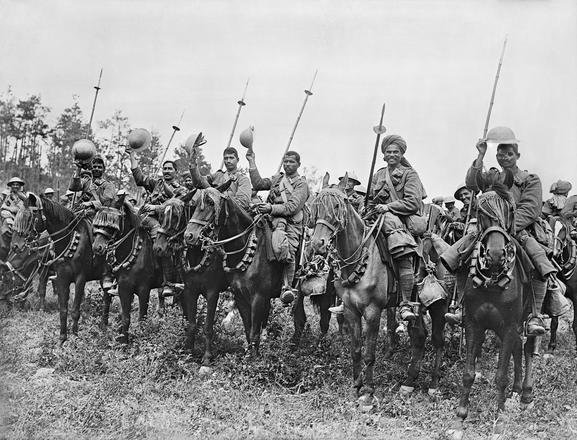
Members of the Indian cavalry on the Western Front

Officials at the London Borough of Hillingdon are asking local residents to share their World War I memorabilia.

The west London council is planning its commemoration of the Centenary and local historians are looking for anyone with letters, photographs, diaries, medals or other militaria to form part of an exhibition.

Areas of particular interest include the Western front, the role of women and the experiences of ordinary Londoners. Hillingdon being a racially diverse borough, officials are also keen to emphasise the contribution made by troops from the Commonwealth – in particular nations such as India, Pakistan and Bangladesh.


Posted in Events | Tagged , , , , , , , | Leave a comment

A draft of reinforcements arrives at Ypres

Messines

Norman Gladden recalls how a new draft of men arrived at the 11th Battalion, Northumberland Fusiliers near Ypres in 1917. The battalion had suffered considerable casualties at the Battle of Messines on 7 June 1917.

The nature of the new arrivals shows how conscription was bringing older men into the army and how battalions were losing their regional identity. It also demonstrates how dangerous it was to be a member of an infantry battalion in World War I – many of those Gladden mentions did not survive.

‘A large draft from home had now joined us to fill the gaps left by the recent battle. They were all new to active service and had much to learn, a mixed group, coming from all parts of Britain.

Among those I was to come to know very well were Tom Ireland, tram conductor from Bradford, old to us in his forties, with whom I was to maintain friendly correspondence right up to the eve of the Second World War, and Isaac Doniger, from Leeds, a kindly generous Jew whose friendship I treasured until his death in 1965.

There was also [Ernest] Canelle, a well-educated Second Division Clerk in the Civil Service, destined to take the place of Jimmy Downs and Harold Eldred in my affections. (As an example of our addiction at that time to surnames, I mention that I do not recollect his Christian name).

These new-comers were homely folk, a sample of the ordinary men of England, who were not awed by their new surroundings. Ready to learn and to respect the service of those who had already seen so much that was still hidden from them, they were quickly to be admitted to this new society and made to feel at home.

Two other members of this new group I remember well, though they never entered the inner circle of my acquaintances. One was Broome, probably in his thirties – he seemed old to us – a tubby, short, good-natured chap, whose great love of his missus beamed habitually from his countenance. He came from t’Potteries and ended most of his sentences with the phrase ‘ther knowst’.

The other was young Harkins, open, frank and full of joie de vivre, destined to become one of the most popular members of the company and an NCO capable of leadership without sacrificing that popularity.’

Posted in Soldiers of the Great War, World War I memoirs | Tagged , , , , , , , , , , | Leave a comment

Researchers baffled by World War I soldier’s shorthand diaries

Image

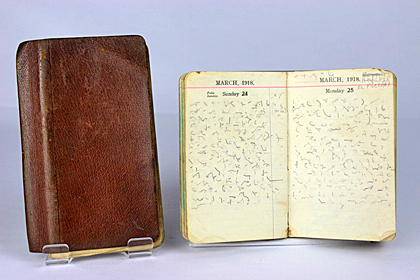
William Reader’s diary, complete with shorthand notes

Two diaries, written in shorthand almost a century ago and donated by a local Old Comrades Association, have led researchers at York Castle Museum to make a public appeal for translators to help in understanding them.

Corporal William Reader, of C Squadron, 1st East Riding Yeomanry, is thought to have filled the books with notes and thoughts during the Palestine Campaign. Unfortunately, though, his writings have proved impossible to decipher.

Fascinating project

The soldier wrote his diaries during 1917 and 1918, but the museum says it has found ‘very little’ accompanying information about them.

‘This is such a fascinating project,’ said Alison Bodley, curator of history at the museum. ‘We have in our possession two diaries from nearly 100 years ago, but we can’t understand what has been written in them.

‘It would be fantastic if volunteers from the public could give us any insight as to the content of the diaries and tell us more about the shorthand itself.’

The journals will go on display as part of the museum’s exhibition 1914: When the World Changed Forever, which will open on June 28.

Email katie.brown@ymt.org.uk to help

Posted in Events | Tagged , , , , , | Leave a comment

Life behind the lines in World War I

Image

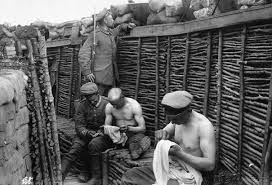
German soldiers on the lookout for lice

Norman Gladden, of the 11th Battalion, Northumberland Fusiliers, recalls the ordinary soldiers’ experience in an area behind the British lines near Ypres in 1917.

‘One day we marched to the Brigade Baths which had been set up in a small village a kilometre or so beyond Fletre. As welcome as the bath – at least to those of us who still had money to spend – was the well stocked canteen somewhat incongruously installed under the same roof. There was a small battalion canteen in a shanty at the entrance of our own camp, but it was usually sold out.

‘On another occasion we were ordered to take all blankets and spare clothing to the army fumigator which had been temporarily set up in the village. This was a Heath Robinson kind of contraption, consisting mainly of a large barrel-shaped thing into which steam was pumped under pressure. The object was to kill our resident lice, but the effect, we were soon to be convinced – apart from making everything bedraggled and tarnishing the buttons – was to incubate a new generation of lice from the eggs with which the seams of our clothing were always prolifically sown. Within a matter of hours we became as itchy as ever.

‘On reaching the chugging monster we had to take off our tunic and trousers and to wait around in our greatcoats while the machine did its worst. Dressed thus in our underclothing amidst the inhabited buildings of that little place we felt very much at a disadvantage, pulling our coats around us and watching fearfully lest some of the natives should stroll over to see what was going on.

‘The unavoidable intimacies of army life had apparently not killed the natural modesty in which most of us had been brought up.’

Posted in Soldiers of the Great War, World War I memoirs | Tagged , , , , , , , , , | 1 Comment

Remembering Charles Chilton: writer of Oh What a Lovely War!

Image

Charles Chilton, who died on 2 January at the age of 95, was a writer and producer who was responsible for several well-known classic BBC series such as Lost in Space and Riders of the Range.

He also wrote the play, Oh What A Lovely War! a jaunty, ironic and cutting interpretation of World War I.

Killed in action

In writing the play, Chilton was remembering his father, private Charles Henry Chilton of the 6th Battalion, Notts and Derbys Regiment, who was killed, aged 19, on 20 March 1918 – the first day of the German Spring Offensive.

He had not had the opportunity to meet his son, who was born nine months before his death, having been posted to the Western Front a few weeks before the latter’s birth.

Like many of those who lost their lives at this stage of the war, his body was never found and he is commemorated on the Arras Memorial to the Missing. In the 1960s, Chilton went in search of his father’s grave in northern France and eventually found his name on the memorial, surrounded by those of more than 30,000 others.

Long-lost programme

The experience inspired a radio programme, aired in 1961, that told the tale of the war through the songs sung by British soldiers. It provides a fascinating selection, from the well-known tunes such as It’s a Long Way to Tipperary and The Bells of Hell Go Ting-a-ling-a-ling to lesser known ditties, often adapted from the hymns the soldiers would have sung since their early boyhood, such as We are Fred Karno’s Army – sung to the tune of The Church’s One Foundation. Two years later this programme was adapted to become the script for Oh What a Lovely War!

It was thought the radio show had been lost forever, but not long before his death Chilton unearthed a copy that he had kept. It is now held in the archives of the British Library in London.

To listen to the programme, click here.  

Posted in Events | Tagged , , , , , , , , | 1 Comment