Lincolnshire couple unearth World War I medal in garden

Image

A couple who discovered a World War I medal in their garden are hoping to trace the descendants of Royal Navy sailor to whom it belonged, reports the BBC.

Katie and Paul Roberts from Saxilby in Lincolnshire, found the 1914-15 Star as they dug a new flowerbed.

With the help of a local history group they have discovered the medal belongs to a Sheffield man called Ernest Clarkson.

Mrs Roberts said: ‘It is very interesting and very historic. I’m pleased we found it and hopefully someone will come forward to claim it.’

The couple discovered Clarkson was born in Sheffield in 1890. He joined the armed forces in 1906 and served on HMS Bellerophon.

He married a woman called Edith Tuxford with whom he had five children – Eric, Ethel, Alfred, Doria and Mabel.

The Roberts believe the medal came to be in Saxilby via the Saxilby Canal, a popular venue for Sheffield residents who would come here to fish.

Dr Jane Chapman, professor of communications at the University of Lincoln, told the BBC: ‘He served on a dreadnought in the Navy. They are hugely interesting because the rivalry for building such ships was one of the factors that caused tension between Germany and Britain and led to World War I. He was also at the Battle of Jutland in 1916.’

To read the original BBC story, click here.

Posted in Events | Tagged , , , , , , , , | Leave a comment

Image

A campaign has been launched to commemorate VC winner Private Samuel Harvey in his adopted home town of Ipswich.

Private Harvey, of 1st Battalion, York and Lancaster Regiment, won his medal at the Battle of Loos in 1915.

An account of his actions states: ‘On 29 September 1915 in the “Big Willie” trench near the Hohenzollern Redoubt, France, during a heavy bombing attack, more bombs were urgently required and Private Harvey volunteered to fetch them.

‘The communication trench was blocked with wounded and reinforcements and he went backwards and forwards across open ground under intense fire and succeeded in bringing up 30 boxes before he was wounded in the head. It was largely owing to his cool bravery in supplying the bombs that the enemy was eventually driven back.’

Harvey was 30 years of age at the time and had three brothers in the Army at the time.

Born near Manningtree, he enlisted at the age of 19 at Doncaster, and served seven years with his regiment in India, proceeding into the reserve a few weeks before the war broke out.

Private Harvey went out with the original Expeditionary Force and had been wounded twice before the battle of Loos.

About the middle of September 1915 Private Harvey was looking forward to a holiday in England. His regiment was at Béthune, when it was ordered back to the firing-line, the journey being made by motor-lorry.

The men of the York and Lancaster Regiment were disappointed at losing their well-deserved rest, but this quickly passed when they became aware that big things were about to take place. ‘We longed to be in it again,’ said Harvey, ‘rather than going home’.

His regiment went straight into action, to assist the Canadians, who were surrounded by German bomb-throwers. Certain trenches had been lost, and the men of the York and Lancaster Regiment were ordered to regain them.

Harvey lived in Ipswich after the end of the war. He worked as an odd job man, but developed a fondness for alcohol, perhaps as a result of his wartime experiences, fell on hard times and was often to found sleeping rough in the town centre.

He died on 23 September 1960, aged 79, at Stowmarket in Suffolk. His only possession was his miniature VC medal group.

It is rumoured he had traded the full size medal for drink many years earlier.

He was buried in an unmarked grave, which was given a headstone in 2000 after a local campaign.

Posted on by DH | Leave a comment

Scottish World War I poster collection to appear online

Image

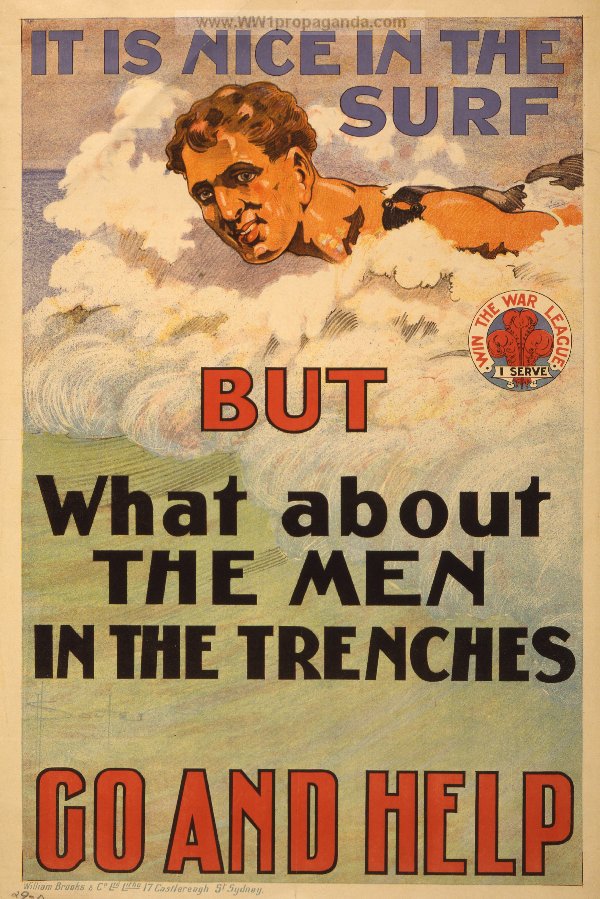
A collection of World War I propaganda posters is to be made available online as a digital archive.

Around 300 posters that were collected by the secretary of the McLean Museum in Greenock, Scotland, during the conflict are being digitised after the award of a £51,300 Heritage Lottery Fund (HLF) grant.

The museum’s assistant curator, Vincent Gillen, said: ‘From 1914 the secretary of the museum, Thomas Thomson, had the foresight to write to the High Commissions and embassies of the countries fighting against the Germans and their allies asking for examples of posters.

‘He was sent recruitment adverts and propaganda posters from Britain, France and Ireland as well as material from America and Canada. Some are very rare and all of them are in near perfect condition as they were sent directly to the museum and have been safely stored away ever since.

‘It is a unique collection and one that I am sure will be very popular when it is available online.’

The collection will go online as part of Scotland’s commemoration of next year’s Centenary of the start of World War I.

Inverclyde Council’s communities vice convener, councillor James McColgan said: ‘This incredible collection shows the vast range of messages being promoted in the lead up and during the conflict, from recruitment posters urging men to join up and promotional posters calling for people to help fund the fighting through war bonds. There is even a collection of rare German propaganda posters.’

Posted in Events | Tagged , , , , , , , | Leave a comment

New daffodil to commemorate Gallipoli fallen

Image

A new daffodil has been created to commemorate soldiers who fought and died in the Dardanelles campaign of 1915.

Expert grower Ron Scamp has named his new variety Gallipoli Dawn and he hopes the flower will raise much-needed funds for the organisation set up to remember those killed and wounded in the fighting.

Scamp grows more than 3,000 varieties of daffodil – the largest collection in the world – in Falmouth, Cornwall.

He said: ‘I made the first “cross” of this daffodil in 1992, it first flowered in 1997 and it usually takes another six to 12 years to develop to a commercial variety.

‘This daffodil is an all-yellow, strong growing variety for the garden and has already won prizes in exhibition. When the Gallipoli Association approached me and asked me if I had a variety that could be named for the centenary commemoration I was deeply honoured.’

Lyn Edmonds, executive officer for the Gallipoli Association’s G100 centenary committee, said Scamp will be making a donation from every sale. This will be used to boost funds aimed at taking British schoolchildren to the battlefields where thousands fought and died.

Edmonds added: ‘Our image of the Gallipoli campaign is usually one dominated by memories of Australian and New Zealand troops, the Anzacs. Of course, it’s right to recognise their bravery and sacrifice, but in fact far more British servicemen died in the campaign and we are determined to ensure their contribution is not forgotten as the Centenary approaches.’

Specimens of the Gallipoli Dawn daffodil are available by emailing: rascamp@daffodils.uk.com or via the website: www.qualitydaffodils.co.uk

Posted in Events | 3 Comments

RBL poppy planting campaign saved after HLF snub

Image

A Royal British Legion project to plant poppies across the UK has been saved, despite its being turned down for Heritage Lottery Funding.

The project had applied for £92,000, but this was rejected by the Heritage Lottery Fund (HLF) because it said demands for its grants were so high.

The nationwide project, which had been launched by a legion branch in Greenhithe, Kent, is now being taken over by the organisation’s headquarters, which has recruited B&Q, to carry on the scheme.

The revived campaign will be officially launched next month.

The retailer will sell Flanders poppy seeds from its outlets, with buyers encouraged to sow them on their own land. The proceeds will go towards the legion.

Charles Byrne, the RBL’s director of fundraising, told the Daily Telegraph: ‘The Royal British Legion is pleased to confirm we are rolling out the Centenary Poppy Campaign, across the UK, and in partnership with national retailer B&Q.

‘The idea to distribute poppy seeds to commemorate the centenary of World War I originated in the Legion’s Greenhithe and Swanscombe Branch, who are working with us to establish this campaign on a national level.

‘We want to see members of the public making this campaign their own in their local communities, working in collaboration with local government, schools and community groups, and we will be taking discussions forward with central government to engrain this campaign in the centenary commemorations.’

The decision by the HLF to turn down the grant application was controversial. Lord Guthrie, a former chief of the defence staff, said: ‘It is quite a strange decision and a very unfortunate one. It seems on the face of it to have been a wonderful project.’

The HLF has not provided full reasons for rejecting the application. However, it has suggested it simply judged other schemes to be more deserving in what it described as a ‘highly competitive funding round’.

News of the rejection came only a day after it emerged that the HLF had awarded almost £100,000 to the Peace Pledge Union (PPU), a pacifist organisation, to raise awareness of the role of conscientious objectors during the World War I.

The HLF had approached the PPU and urged its organisers to apply for funding.

The Telegraph points out that other recent grants by the lottery distributor have included £69,400 to produce an archive and exhibition about Polari, a language used in the gay community in the 1960s; £46,000 for a museum dedicated to ‘South Derbyshire’s production of sanitary ware, toilets and sewage pipes’ ; and £42,000 to create an exhibition, Defining Me: Musical Adventures in Manchester, about the impact that musicians such as Bob Dylan and the Sex Pistols have had on the city.

David Davies, the Conservative MP for Monmouth and a former soldier in the Territorial Army, told the newspaper: ‘It is particularly irksome that the HLF is throwing money on celebrating the role of those who refused to fight, but cannot reach into its pockets to find a little more to remember those who died. It is absolutely disgraceful and I think many people will be in despair at the kind of thing that lottery money is allocated towards.’

Campaigners said the poppy bid had been rejected in a three-line email from the HLF.

To read more about the poppy planting campaign, click here.

Posted in Events | Tagged , , , , , , , , | Leave a comment

VC winners commemorated in home towns

Image

Each World War I Victoria Cross recipient in Britain will have a stone laid in his or her home town as part of the World War 1 Centenary commemorations in 2014.

In Nantwich, Cheshire, for example, second lieutenant Stanley Henry Boughey of the Royal Scots Fusiliers will be remembered.

Boughey, whose family lived at Yew Tree Farm in Hurleston, Nantwich, was killed in action in Palestine in December 1917 aged 21.

He won his VC for stopping a Turkish attack and taking 30 soldiers prisoner during a battle in El Burff near Jerusalem. He was killed shortly afterwards and is buried in the Gaza War Cemetery.

An extract from the London Gazette of 12 February, 1918, states: ‘For most conspicuous bravery. When the enemy in large numbers had managed to crawl up to within 30 yards of our firing line, and with bombs and automatic rifles were keeping down the fire of our machine guns, he rushed forward alone with bombs right up to the enemy, doing great execution and causing the surrender of a party of 30.

‘As he turned to go back for more bombs he was mortally wounded at the moment when the enemy were surrendering.’

Boughey had previously been a member of the Red Cross in Flanders and had also served with the Ayrshire Yeomanry.

Posted in Events | Tagged , , , , , , , , , , , | Leave a comment

Charity searches for relatives of first British casualty

Image

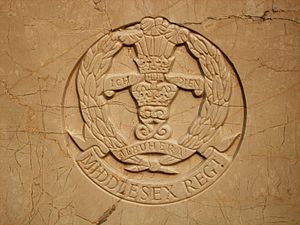
The Barnet War Memorials Initiative Trust is looking to install a memorial to private John Parr, of 4th Battalion the Middlesex Regiment, who was the first British soldier to be killed in World War I. It is also hoping to track down relatives of the soldier.

Parr was born in 1897. The son of a milkman, he spent most of his life living in Lodge Lane, Finchley, with his six older brothers and sisters.

He worked as a golf caddie at the North Middlesex Golf Club before joining the Middlesex Regiment aged 15 in 1912, having told his recruiting officer he was 17.

Private Parr was sent out on reconnaissance on 21 August 1918, but encountered a German patrol near the village of Obourg and was shot dead.

He is buried in the St Symphorien Military Cemetery, just south of Mons, in Belgium, where his headstone mistakenly gives his age as 20.

The trust’s secretary, Stephen Sowerby, said: ‘We had in Barnet the first casualty of so many in that conflict, so we thought it would be fitting when commemorating this event to commemorate this individual.

‘The family seem to have disappeared from history. It would be so nice for us to speak to them and see how he is remembered.

‘It would also be nice to have a family member involved in the erection of the plaque next year.

“We know private Parr had a big family from Barnet as well as Haringey, so there may still be some members around.’

Anyone with any information about private Parr is invited to email Mr Sowerby at cllr.s.sowerby@barnet.gov.uk

Posted in Events | Tagged , , , , , , , , , , , | Leave a comment

How the Kaiser freed British officer to visit dying mother

Image

Historian Richard Van Emden has uncovered the story of how captain Robert Campbell was freed by the German Kaiser so he could visit his dying mother.

The Daily Telegraph reports how the 29-year-old Campbell was captured at the battle of Mons in 1914 and had spent two years in the Magdeburg prisoner of war camp when he heard his mother, Louise, was dying of cancer.

He wrote to Kaiser Wilhelm II, asking to be allowed home to visit her. The German monarch was moved by his story and allowed him two weeks’ leave, on the condition he gave his word as a gentleman that he would return when his time was up.

Van Emden told the Telegraph: ‘Captain Campbell was an officer and he made a promise on his honour to go back.

‘Had he not turned up there would not have been any retribution on any other prisoners.

‘What I think is more amazing is that the British army let him go back to Germany. The British could have said to him: “You’re not going back, you’re going to stay here.”‘

‘I think it is such a unique example that I don’t think you can draw any parallels. In my experience this is a one off.’

Captain Campbell was serving with the 1st Battalion, East Surrey Regiment when he was captured in August 1914.

Freed from captivity in 1914, he returned home and retired from the military in 1925.

He rejoined in 1939, taking up the role of chief observer of the Royal Observer Corps on the Isle of Wight for the duration of World War II.

He died in July 1966 aged 81.

Posted in Events | Tagged , , , , , , , , , | Leave a comment

Butte de Warlencourt Centenary restoration plans

Image

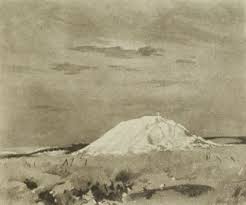
The Butte de Warlencourt, once a strongpoint in the German army’s defences on the Somme front, is set to be restored as a visitor attraction for the Centenary of World War I, reports the Daily Mail.

The Western Front Association (WFA) bought the site 23 years ago for £7,500 from a local farmer to save it from developers.

The WFA now plans to restore the pathway to the summit, install new walkways and handrails, and also place memorial benches around the site. It will also mount information boards on the mound explaining its historical significance.

At 250ft the Butte gave German commanders clear views across the battlefields of 1916.

The Mail quotes lieutenant colonel Roland Boys Bradford, of the Durham Light Infantry, who was awarded a Victoria Cross for his role in an attempt to scale the mound and seize it from the Germans.

“The Butte de Warlencourt had become an obsession,’ he wrote. ‘Everybody wanted it. It loomed large in the minds of the soldiers in the forward area and they attributed many of their misfortunes to it. The newspaper correspondents talked about “that miniature Gibraltar”.’

WFA spokesman Bob Paterson added: ‘Having saved it from destruction this piece of France will continue to be preserved as a fitting memorial to those of all nations who paid the ultimate sacrifice in the fields that surround it.’

The WFA is appealing for sponsorship and donations towards the Butte de Warlencourt restoration project. There is more about the Butte in an article on the WFA’s website, here.

To read the original story from the Daily Mail, click here.

Posted in Events | Tagged , , , , | Leave a comment

Retreat from Mons Remembrance Trail

Image

CWGC has launched a Retreat from Mons Remembrance Trail.

The Battle of Mons was fought on 23 August 1914. Heavy fighting took place in the city and the surrounding area and by the evening the British Expeditionary Force had begun a tactical retreat. In the two weeks that followed, the British units fell back all the way to the outskirts of Paris – around 200 miles away.

The remembrance trail tells the story of those times and of the men who were involved.

It comprises 10 CWGC sites, beginning with St Symphorien Military Cemetery on the outskirts of Mons, where the first British casualty of World War I, private John Parr of the 4th Battalion Middlesex Regiment, is buried.

Other places on the trail include Le Cateau Military Cemetery, where British casualties from 1914 were buried close to a site that later became a major German hospital centre. 

Etreux Military Cemetery is the last resting place of many members of the 2nd Battalion Munster Fusiliers, whose rearguard action helped the British III Corps escape.

Néry Communal Cemetery is near where soldiers from the Royal Horse Artillery and several cavalry units who held back a much larger German force on 1 September 1914.

La Ferte-sous-Jouarre Memorial commemorates almost 4,000 officers and men of the BEF who lost their lives at the battles of Mons, Le Cateau, the Marne and the Aisne between August and September 1914.

The trail also tells the story of some of the men involved in the retreat by using interpretation boards and mobile phone downloads. Among them is lieutenant colonel George Morris of the Irish Guards, who was killed on 1 September 1914 as the 4th (Guards) Brigade fought a rearguard action in the Forêt de Retz near Villers-Cotterêts. He is buried at Guards’ Grave Cemetery.

CWGC suggests the 250-mile trail is completed over two to three days. Driving time involved is around six hours.


Posted in Events | Tagged , , , , , , , , , , , , | Leave a comment