Romford firemens’ bravery remembered

Image

The Romford Recorder reports of an almost forgotten episode that involved the district’s firemen during World War I.

Chris Van-Holby, grandson of one of the men involved, told the newspaper: ‘During World War I, Romford Fire Brigade was called to a fire at a munition factory on the River Thames.

‘The bravery of the Romford crew went unreported until the end of the war but eventually six firefighters were to receive the OBE from the King for the parts they played in rescuing several young women from a munitions factory at Rainham.

‘The building was well ablaze when the Romford crew arrived with their equipment comprising wet cloths to aid breathing, a whistle and a hank of string to keep them together, they removed 12 young women who all survived.

‘Minutes later the factory was blown hundreds of feet into the River Thames.

‘An inquiry found sadly that the cause of the fire was the night watchman smoking a cigarette in the powder room.’

To read the full story, click here.
Posted in Events | 1 Comment

Islington memorial to Finsbury Rifles – 11th London Regiment

Image

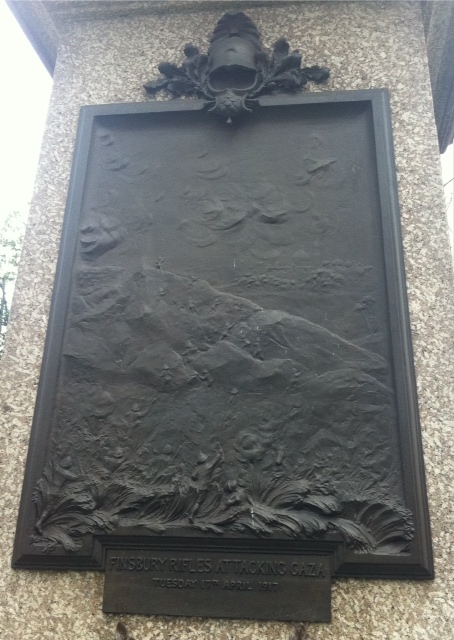
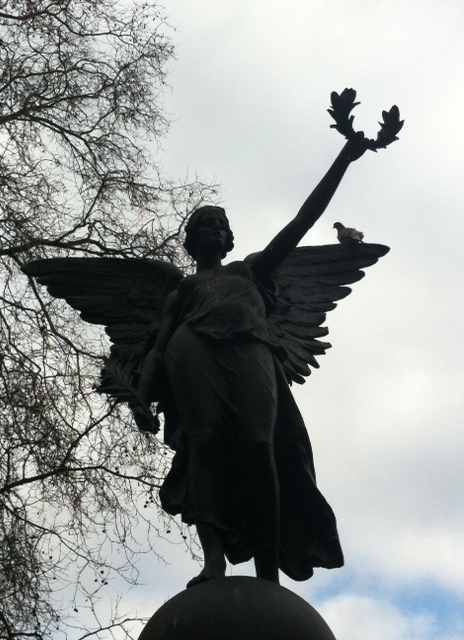
Just south of Angel Underground station in Islington is the Finsbury war memorial.

Depicting a winged victory, who looks somehow 1920s in dress and shape, holding a laurel wreath, it has four panels at its base.

One of these depicts the 11th Battalion London Regiment’s (Finsbury Rifles) assault on Gaza in April 1917. There used to be two more – one depicting the attack on Zeebrugge, the other the battle at Piave (in 1918 in Italy) – perhaps because so many Italians and people of Italian extraction lived in this area. Appallingly, he latter two were both stolen some years ago.

The Gaza plaque perhaps survived because it faces the road and so could not be removed without the culprits being spotted. 

Image

The Finsbury Rifles took part in the Gallipoli campaign before being sent to Egypt. After two failed assaults on Gaza, the third offensive took place in November 1917 with air cover from Bristol Fighters (an aircraft is depicted on the plaque though it depicts an earlier engagement). 

Lance corporal John Christie of the Finsbury Rifles was awarded the VC the following month, on 21-22 December 1917 at Fejja, Palestine. His citation reads that he fought off a Turkish counter-attack using bombs in spite of being heavily outnumbered and exposed to enemy fire.

Christie was a parcels clerk at Euston Station who joined the regiment in September 1914. Wounded in the head at Gallipoli, he rejoined his battalion in November 1915 and then took part in its engagements in Palestine.

There is more about L/Cpl Christie on the Kings Royal Rifle Corps site here.

Posted in Events | Tagged , , , , , , , , , , , | 8 Comments

Machine Gun Corps Old Comrades’ memorial project

Image

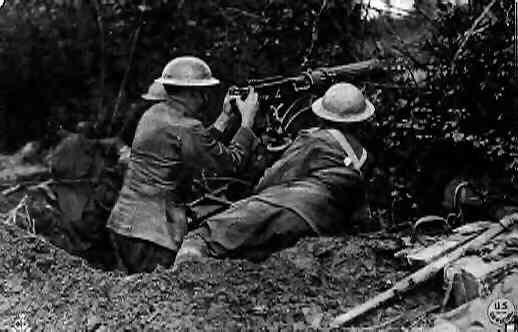
The Machine Gun Corps (MGC) Old Comrades’ Association is attempting to photograph all MGC graves and names on memorials.

It is hoping to commemorate every MGC soldier who lost their life during World War I. The MGC Old Comrades’ Association can provide a list of graves and memorials it needs photographed.

The MGC only existed for only eight years, but its Old Comrades’ Association still thrives many years after the unit ceased to exist and long after its last surviving member passed away.

The regiment was a dangerous place in which to serve. It was badly mauled during the spring offensive of 1918 as its members attempted to cover the retreat of other British troops and generally machine gunners were favoured targets of snipers. The MGC had the nickname of ‘The Suicide Club’ for good reason.

Anybody with an interest in the MGC and World War I history can join the Association. Annual membership is £13 and available via the website, which can be visited here.

Posted in Events | Tagged , , , , , , | 1 Comment

Leicestershire Regiment photos at WW1tigers.com

Image

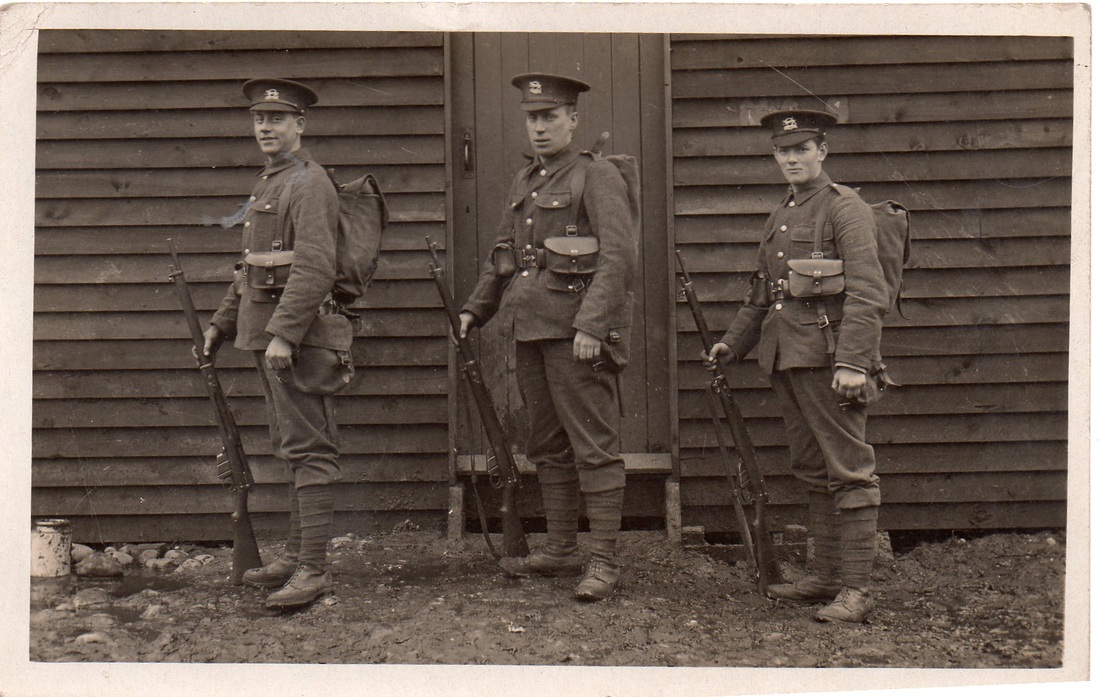
Leicestershire Regiment soldiers in marching order

Website ww1tigers.com brings together a fascinating collection of images of soldiers from the Leicestershire Regiment.

The site states that it is dedicated to the memory of the 7,028 soldiers of the regiment who died in World War I.

Its aim is to identify as many of the photographed men as possible. The images are all intriguing in their own right. Many depict soldiers posing in studios for photos, but others were taken in barracks or on active service.

They also show a number of individual styles of kit and dress – with different styles of cap, for example. In addition, the site includes photos of various types of memorabilia from the regiment: cap badges, shoulder titles and trench art.

Image

The soldier on the right wears machine gunner and marksman badges


Posted in Events | Tagged , , , , , | Leave a comment

Turkish plan to find missing soldiers of Gallipoli

Image

The geophysical engineering department at Çanakkale Onsekiz Mart University’s (COMU) faculty of engineering, the Turkish Ministry of Forestry and Water Affairs and the Gallipoli Historical National Park Directorate are attempting to find the last resting places of soldiers killed at Gallipoli in 1915.

Worldbulletin.net reports that the trio are attempting to find 18 out of the 28 burial sites depicted on a 1916 map compiled by the Turkish military.

Researchers intend to use ground-penetrating radar and magnetic measurements to discover the sites.

Nearly 1 million soldiers fought at Gallipoli. The allies recorded 55,000 killed in battle with 10,000 missing and 21,000 falling victim to disease. Turkish casualties were estimated at around 250,000.

For the original story click here.

Posted in News | Tagged , , , , , | Leave a comment

World War I soldier’s letters uncovered in Toronto house

url-1

Canadian troops on the Western Front

A collection of letters, photos and postcards dating back to the First World War has been discovered in a house in Toronto, Canada, reports Canadian broadcaster CBC.

The letters were sent to a woman named Hilda MacLeod apparently by a soldier named NE Waring, who describes life in the trenches of the Western Front.

They were found by Joel Cormier and Ashley Cameron in a box in their attic. The pair are hoping to return the letters to relatives.

For a full video report from CBC click here.

Posted in News | Tagged , , , | Leave a comment

Image

The remains of British soldiers could be disturbed if a plan to build a wind farm on the site of the Loos battlefield goes ahead.

The Daily Mirror reports that Energy firm InnoVent wants to build 10 turbines on the site of the 1915 battle.

The newspaper adds that the Leicestershire Regiment alone lost more than 500 men during the battle and quotes military historian Richard Lane, who said: ‘There are likely to be the remains of those who died which could be disturbed.’

Plans for the wind farm were submitted by the French firm last year but only emerged last week following a public meeting in Calais.

The final decision on whether it can be built lies with region Nord Pas de Calais.

InnoVent spokesman Clement Prouvost said: ‘We will keep turbines a minimum distance of 600 yards from cemeteries.’

For the original story, click here.

Posted on by DH | Leave a comment

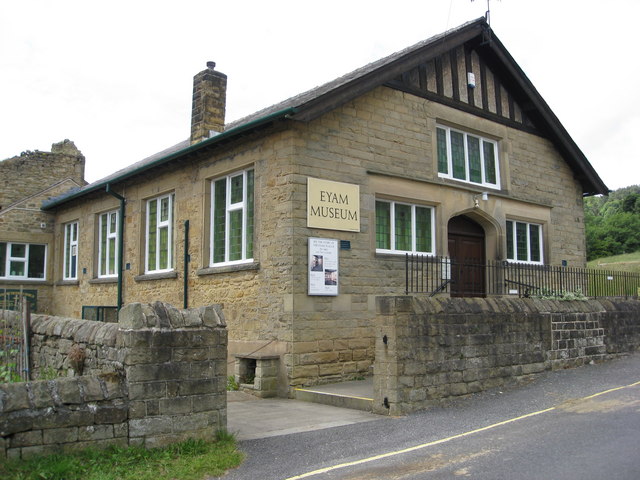
Eyam Museum, Derbyshire, to stage World War I exhibition

Image

Eyam Museum in Derbyshire intends to put on a World War I exhibition thanks to a £21,000 grant from the Heritage Lottery Fund.

News website ThisisDerbyshire.co.uk reports the exhibition will open in March 2014. As well as the centenary of World War I, Eyam will also be commemorating the 350th anniversary of the arrival of the bubonic plague in the village.

Villagers sacrificed their lives at that time to contain the outbreak within the village.

Vanessa Harbar, head of the Heritage Lottery Fund East Midlands, said: ‘This is a wonderful and intriguing project that serves to commemorate the impact of the First World War on Eyam and its residents.’

To read the original story click here.

Posted in Events | Tagged , , , , | Leave a comment

Relatives of soldier and nurse brought together at IWM North

Image

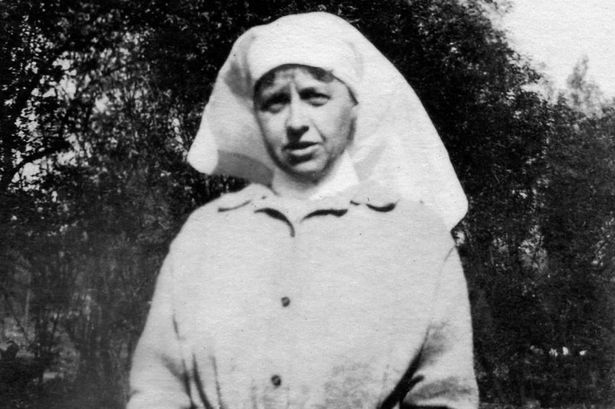
Sister Edith Appleton during World War I

The Manchester Evening News reports the moving story of sister Edith Appleton and private Charles Kerr, of the 17th Battalion Manchester Regiment.

Sister Appleton kept a journal focused on what she witnessed during five years on the Western Front and her words have been published in a book (War Diaries: A Nurse at the Front).

One of the episodes she records is how she looked after private Kerr in the days before he died from the effects of gas, bronchitis and pneumonia in France on 12 March 1916.

The newspaper reports how his great-great-niece Nicola Mortimer has been able to meet Edith’s great-nephew Dick Robinson, who got the diaries published after retrieving them from a drawer. They met at the Imperial War Museum North.

Sister Appleton named more than 200 people in her diaries, including many soldiers who passed through her field hospital in northern France.

Pte Kerr was 21 when he died in the town of Etretat. Nicola has no photographs of him.

The Imperial War Museum North is hosting an exhibition called Saving Lives about battlefield medicine and care, which runs until September.

For the Manchester Evening News story click here.

Posted in Events, Soldiers of the Great War | Tagged , , , , , , , , | Leave a comment

World War I relics at Rainham Marshes RSPB reserve

Image

The RSPB’s Rainham Marshes reserve has kept rather a lot of World War I heritage.

Amid its reedbeds and walkways is a stubby, circular tower, just in the shadow of the River Thames’ flood bank. During World War I this was used as a lookout post from which soldiers would scan the estuary for enemy submarines attempting to sneak up the Thames. It seems too short for the job, but the embankment was much lower 100 years ago than it is today.

Legend has it that, in 1916, a machine gun, mounted on the top of this tower, helped to shoot down the German zeppelin LZ15 as it made its way towards London.

A mural of that engagement is one of several that adorns the remains of a steel-lined earthwork at one end of the reserve. Backed by several feet of earth, this was where soldiers lifted up paper targets on long, wooden poles to be shot at by their comrades at the other end of the range.

IMG_1750

Original numbers at the surviving butts, Rainham Marshes

A segment of the butts still stands, with tall numbers, a bit like those on a running track, still standing proud against the skyline. Nearby, the digits recur atop a purpose-built hide that affords superb views of the wetlands.

The railway line that once brought troops here today carries Eurostar services that thunder past the edge of the reserve, seemingly without concerning the wildlife. Somehow, though, the presence of the trains does not make the marshes feel any less remote and the haunting cry of a curlew, drifting in from the estuary, only adds to that feeling of mystery and isolation.

That feeling was perhaps shared by the troops who were based here during World War I, among them, in 1914, soldiers from the 18th (Eastern) Division, who lived under canvas until huts were built as the winter set in.

IMG_1753

Water fills the area where troops would have raised targets above the bank

Posted in News | Tagged , , , , , , | Leave a comment