Hislop and Palin join forces on Wipers Times film

Image

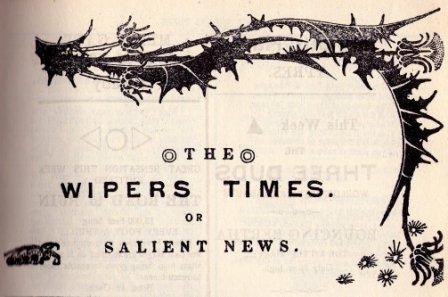
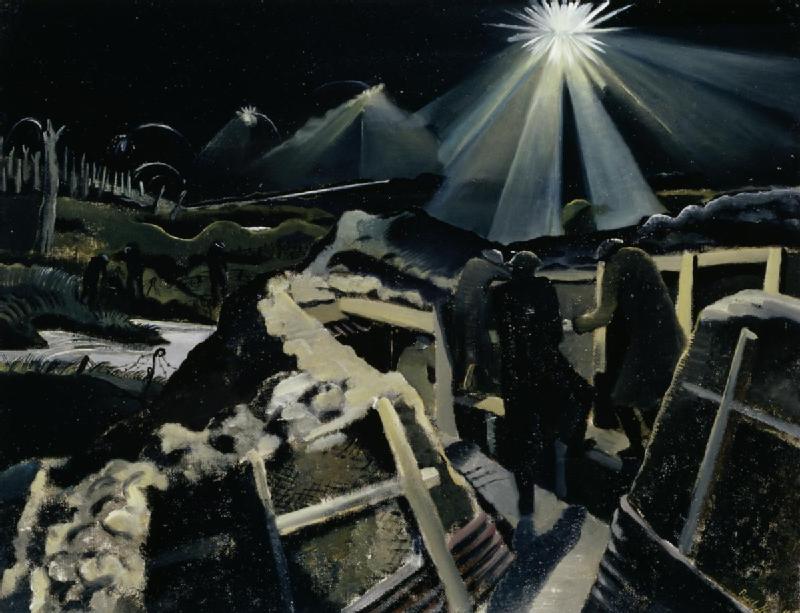
Michael Palin is to star in a BBC Two film about a satirical magazine published during World War I, reports chortle.co.uk.

The film, The Wipers Times, has been written by Ian Hislop and Nick Newman and is based on the true story of Captain Fred Roberts who found a printing press in a ruined building in Ypres, Belgium, in 1916.

It published articles making fun of the situation in which British troops found themselves, with cartoons, poetry and humorous ‘advertising’.

Ben Chaplin will play Captain Roberts, of the 12th Battalion Sherwood Forresters, while
Palin co-stars as General Mitford, a supporter of the paper, who recognised its worth to morale.

Ballywalter Park Estate in County Down is providing the backdrop for Ypres and the Somme, and filming will take place across Northern Ireland over the next few weeks.

Posted in Events | Tagged , , , , , , , , , | Leave a comment

Two World War I brothers commemorated in East London

Image

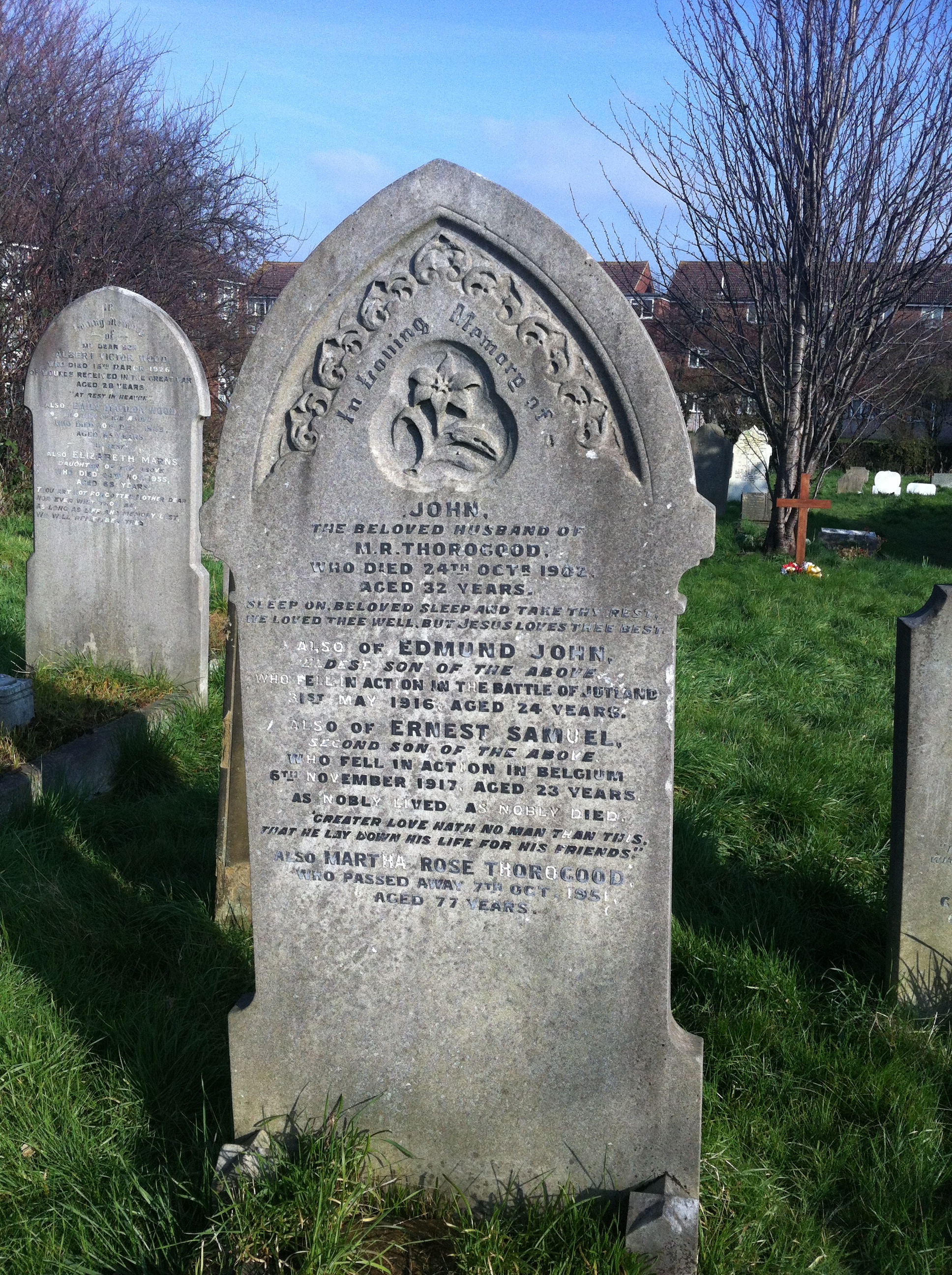
Tucked away at the back of churchyard in east London is this gravestone that tells the sad story of how a widowed mother lost two of her sons in World War I.

Edmund John Thorogood was a gunner in the Royal Marine Artillery aboard HMS Queen Mary and was killed at the Battle of Jutland on 31 May 1916.

HMS Queen Mary was a 27,000 ton battlecruiser that exploded and sunk after being hit by several shells. Of her 1266 crew, only 18 survived. There is a YouTube video of the wreck here.

In the 1911 census Edmund’s job is listed as telephone assembler, probably for the Sterling Telephone and Electric Company. He was living at 69 Victoria Road, Barking.

Ernest Samuel Thorogood was an acting bombardier in C Battery, 108th Brigade, Royal Field Artillery. He died on 6 November 1917 and is buried at Ruisseau Farm Cemetery near Langemark, Ypres. In the 1911 census his job is reported as armature winder.

CWGC lists their parents’ address as 95, Faircross Avenue, Barking, Essex – although their father died in 1902.

Very sad to think of their mother, Martha Rose, bringing up these two boys, perhaps on her own, only to lose them both aged 24 and 23 within just over a year of each other.

According to the 1911 census Martha also had three younger children. Alfred James (14), who was working as a junior clerk at the time, John Hector (10) and Elsie Grace (8).

The Thorogood gravestone is in the graveyard at the parish church in Dagenham.

Posted in Soldiers of the Great War | Tagged , , , , , , , , , , | Leave a comment

Kings Liverpool Regiment soldier reinterred in Swinton

Image

A First World war soldier from Swinton, Lancashire, has been reinterred, after his original burial site was scheduled to become the site of a supermarket.

Private Wilbraham Lomax Blears (23) of 13th Battalion the Kings Liverpool Regiment died from the effects of mustard gas inhalation on 14 May 1918. A grocery assistant with the Co Op in Swinton, he had originally enlisted in the Manchester Regiment in February 1916. He served in Egypt and France before being gassed and sent home for treatment towards the end of 1917.

Although buried in the same plot as his grandparents, aunts and mother at the Swinton Unitarian chapel, no living relatives could be found prior to the reburial service.

The Manchester Evening News reports Private Blears’ funeral was still attended by more than 70 people, including veterans from the Royal British Legion.

resizeimage

Posted in News, Soldiers of the Great War | Tagged , , , , , , , | Leave a comment

South African UK Legion commemorate SS Mendi sinking

Image
Members of the South African UK Legion have held the first-ever memorial service at Portsmouth (Milton) Cemetery to commemorate the casualties of SS Mendi.

In February 1917, the 4,000-ton SS Mendi, carrying troops from the 5th Battalion, South African Native Labour Corps, when she was cut in half by the much larger SS Darro, an empty meat ship bound for Argentina.

Within 20 minutes, the Mendi had sunk off the coast of the Isle of Wight.

The disaster claimed 646 lives, 616 South Africans and 30 British crew, most of whom were never found. But nine bodies washed up at Portsmouth and were buried in Milton Cemetery.

Peter Dickens, 45, chairman of South African Legion UK, said: ‘It’s a pretty significant parade for us because in South Africa the Mendi is taking more significance as people understand the contribution of black Africans to the First and Second World Wars.’

Posted in News | Tagged , , , , , | Leave a comment

Hessett war memorial, Suffolk

ImageSt Ethelbert’s church in Hessett, Suffolk, dates back to the 15th century and is famous for its medieval wallpaintings.

Outside the church is a war memorial for the First World War with 14 names on it.

Seven of these fell in 1918, two each in 1917, 1916 and 1915 and one in 1914. Inside the church is a list of the 52 men who served in the conflict.

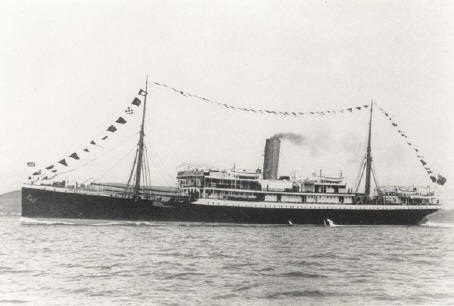
The first name on the memorial is that of William Hubbard. CWGC has two men of this name listed for 1914 – the first of these was a stoker on the heavy cruiser HMS Cressy (pictured above), who was killed when the ship was torpedoed on 22 September by U9. HMS Cressy was already obsolete by 1914 and was largely crewed by Royal Naval reservists when she sank

The other was a private in 1st Battalion the King’s Royal Rifle Corps who died on 17 September. The battalion had landed in France on 13 August.

The 1915 casualties are Herbert Green – probably a lance corporal (service number 12563) in 7th Battalion the Suffolk Regiment, who died on 22 July that year and is buried at Bailleul Communal Cemetery Extension, France. This battalion was raised in Bury St Edmunds in August 1914 and landed in France on 30 May 1915.

The other 1915 casualty is George Stiff, a territorial army soldier of 1/5th Suffolk Regiment who died at Gallipoli on 21 August 1915 and whose names appears on the Helles Memorial to the Missing.

His battalion had only landed at Gallipoli on 10 August and was in action on 12 August, along with the 1/5th Norfolk Regiment – the Sandringham Battalion which was reputed to have vanished into a cloud, but which in reality was cut off and had many of its members killed.

It is possible George Stiff succumbed to wounds sustained on 12 August.

Posted in Soldiers of the Great War | Tagged , , , , , , , , , , , , , , , | Leave a comment

The effect of a shellburst as seen by a First World War soldier

url-2

A First World War soldier reflects on his first experience of shellfire.

‘And was I panic stricken? No. Not in the least. It would be hard to analyse my feelings as I gazed at the ugly brown hole in the green field. Astonishment, excitement, realisation, relief, foreboding, curiosity and even a morbid kind of satisfaction – those emotions possessed me almost simultaneously and left no room for the sensation of fear.

‘Nothing to be frightened of, in fact – provided it did not burst any closer, that is to say. Ah, that was the question: where was the next one coming?’

Private WT Colyer, 28th Battalion London Regiment (Artists’ Rifles).

Posted in Soldiers of the Great War, World War I memoirs | Tagged , , | Leave a comment

Footballer and First World War VC winner Donald Bell

Image

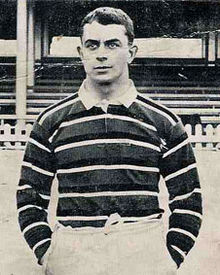
Second Lieutenant Donald Simpson Bell was the only professional footballer to be awarded the Victoria Cross in the First World War.

A native of Harrogate, Yorkshire, he trained as a teacher at Westminster College, London, and was appointed assistant master at Starbeck Council School near Harrogate. He supplemented his income by becoming a professional footballer with Bradford Park Avenue, having already played for Crystal Palace and Newcastle United as an amateur.

He made his debut for Bradford against Wolverhampton Wanderers as a defender on 13 April 1913. In all, he made five appearances for the club before the war broke out in August the following year.

Having been released from his professional contract, Bell signed up as a volunteer with the West Yorkshire Regiment in November 1914 aged 24. He was promoted sergeant in 1915 and by June had been commissioned as a second lieutenant.

His citation for the Victoria Cross reads as follows:

[ London Gazette, 9 September 1916 ], La Boiselle, Somme, France, 5 July 1916, T / Second Lieutenant Donald Simpson Bell, 9th Bn, The Yorkshire Regiment.

For most conspicuous bravery ( Horseshoe Trench, France ). During an attack a very heavy enfilade fire was opened on the attacking company by a hostile machine-gun. Lieutenant Bell immediately, and on his own initiative, crept up a communication trench and then, followed by Corporal Colwill and Private Batey, rushed across the open under heavy fire and attacked the machine gun, shooting the firer with his revolver, and destroying gun and personnel with bombs.

‘This very brave act saved many lives and ensured the success of the attack. Five days later this gallant officer lost his life performing a similar act of bravery.’

Second lieutenant Bell was killed in action on the 10 July 1916, aged 25, south east of Contalmaison. He was first buried where he fell, and later interred in the Gordon Dump Cemetery, Ovillers-la-Boiselle, France, four miles north-east of Albert.

Donald Bell’s Victoria Cross and campaign medals were formerly on display at the Green Howards Museum in Richmond, Yorkshire. They are now on display at the National Football Museum in Manchester.

His medals were sold by Spink of London in 2010 for £210,000

Posted in Soldiers of the Great War | Tagged , , , , , , , , , , , , , , | Leave a comment

Preston announces Centenary plans

Image

Officials at the Lancashire town of Preston are eager to mark the Centenary of the First World War with some major events, reports the Lancashire Evening Post.

Among the proposals are a plan project films of the war in the city’s Market Square to coincide with rededication of Cenotaph in November.

A consortium made up of the Harris Museum, Lancashire Infantry Museum, Ribble Steam Railway Museum and South Ribble Museum have submitted a bid for funding from the Arts Council England’s Renaissance Fund for £285,000.

Plans include the restoration and refurbishment of Sir Giles Gilbert Scott’s original memorial and repairs to damaged stonework.

That will include an inscription commemorating service personnel who have lost their lives in the years since 1945.

Posted in Events | Tagged , , , , , | Leave a comment

Portsmouth Naval Memorial shines light on Scottish rugby legend

Image
His Royal Highness the Duke of Kent will be visiting the Portsmouth Naval Memorial and Southampton (Hollybrook) Cemetery on 19 February to unveil the latest information panels put in place by the CWGC.

The panels carry information about the site and the reason why it is situated where it is. Each panel also carries a code which, when scanned with a smartphone, provides further information, including the personal stories of some of the casualties buried or commemorated at the location.

The code on the Portsmouth Naval Memorial panel reveals the story of David Bedell-Sivright, a Scottish Rugby international who captained the British Lions and died at Gallipoli; and the code at Hollybrook tells more about Lord Kitchener, who is commemorated on the Memorial there.

HRH The Duke of Kent said: ‘The Commonwealth War Graves Commission is at the heart of events to mark the centenary of the First World War. Our cemeteries and memorials will be the focus for many acts of remembrance over the coming years and this initiative will help inform visitors of the historical context which brought these places into being, while putting a human face to the names of those who died. It is a powerful means of combining traditional methods with new technology to ensure we never forget.’

Bedell-Sivright was born in 1880 in Edinburgh and attended Fettes College and Trinity College Cambridge. He gained blues at Cambridge between 1899 and 1902 and was first capped for Scotland in 1900. He went on to win 21 Scottish caps and to represent the British Lions on tours to South Africa (1903) and Australia (1904).

A combative wing-forward, he is rumoured to have once tackled a carthorse in central Edinburgh.

On 25 January 1915 he was commissioned as a surgeon in the Royal Navy and in May 1915 went to Gallipoli with the Hawke Battalion of the Royal Naval Division.

In September 1915 he was attached to the Royal Marine Light Infantry when he complained of being bitten by an insect. He contracted septicaemia and died on 5 September 1915.

Posted in News, Soldiers of the Great War | Tagged , , , , , , , , , , , , | Leave a comment

Scunthorpe war memorial uncovered after 50 years

Image

A First World War memorial that had been stored for 50 years at Scunthorpe’s Old Brumby United Church (formerly St Mark’s Methodist Church) is to be rededicated on 3 March.

Website This is Scunthorpe reports that relatives of any of those named on the tablet are welcome to attend the service.

Among those commemorated on the memorial is Major George Henry Stampe of 24th Battalion the Machine Gun Corps.

Major Stampe was killed on 27 March 1918 during the German offensive Operation Michael and is commemorated on the Pozières Memorial.

The 24th Battalion MGC was formed on 5 March 1918 and was attached to the 24th Division in the Fifth Army. The unit was in action for the period between 21 and 27 March and it is likely Major Stampe was its second in command.

At this stage the British defensive line was crumbling and units of the MGC were often attempting to hold back the attacking German forces to give the infantry battalions an opportunity to retreat.

One member of the 24th Machine Gun Battalion, Private F Plimmer, is quoted in Martin Middlebrook’s The Kaiser’s Battle. He was talking about the action on 21 March, the first day of the Spring Offensive, but his experience may well have been shared by Major Stampe.

‘Over the top of the ridge on our left came the first of the enemy. Not one, or two, or even a small detachment, but a whole line in extended order right across the whole of the ridge. The line of infantry advanced at a walking pace in fairly good order.

‘Then, at an interval of about 20 yards, a second wave appeared, and they kept on coming over the top of the ridge until we had the spectacle of several waves of German infantry advancing in extended order down the slope to Jeancourt. They were very tidy, just as though they were coming down Richmond Hill on parade.’

A total of 170,500 officers and men served in the MGC, of whom 62,049 were killed, wounded or reported missing. The high level of losses earned it the nickname The Suicide Club.

The Pozières Memorial includes the names of more than 500 MGC soldiers who were killed between March and August 1918.

Posted in News, Soldiers of the Great War | Tagged , , , , , , , , | Leave a comment