3177904213

A Scottish researcher is attempting to track down the identity of a oldier featured in a photograph that was given to a girl in Edinburgh during World War I.

Elizabeth Edgar, who kept the photo in her scrapbook, helped her mother, who was a volunteer at the ‘American Hut’ in Edinburgh. The Hut was an entertainment complex for troops, featuring a cinema screen and billiard tables.

The Scotsman newspaper reports that researcher Alistair McEwen, who has created the online archive Edinburgh’s War, is hoping to trace the soldier’s family in time for the centenary of World War I.

‘We would be very keen to identify him as it would be nice for the family that gave me the autograph book to find out who he was,’ he said.

‘That soldier’s photo was inside and there’s a dedication at the front to her [Elizabeth]. We’re wondering, is it possible they knew each other?’

Elizabeth collected autographs, cartoons and poems written by some of the soldiers who passed through the American Hut.

Lance corporal RW Brown, of the 9th Scottish Rifles, wrote in her book in March 1917: ‘What? Write in a book, Where ladies look, and critics spy? Not I, Not I.’
Posted on by DH | Leave a comment

Thessaloniki hospital exhibition tells tale of Balkan front

Image

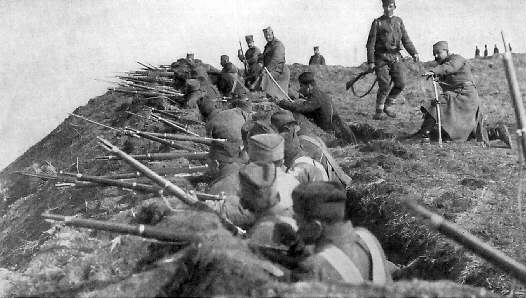
An exhibition entitled Army of the Orient in the Balkans: Archaeological Testimonials of a Hospital in Thermi/Sedes, has opened at the Museum of Byzantine Culture in Thessaloniki, Greece.

Many of the items on show were recovered from the site of a World War I military hospital, reports Ekathimerini.com.

Among the finds were dozens of empty champagne and Burgundy wine bottles, eating utensils, military uniforms, buttons, shoes and coins.

Anastasios Antonaras, one of the archaeologists who worked on the exhibit, told the newspaper: ‘My first impression was that the finds were from an officers’ club and showed how they entertained themselves.

‘It took two years of research before I discovered the bottles found in the dump were reused to store medicine, covering the very sizable needs of the 16 military hospitals that had been set up in Thessaloniki at the time.’

The detrius tells fascinating stories, such as how a soldier may have been saved by a 10-drachma piece, which was found with a bullet impact in its centre.

The recovered buttons are also interesting, as they come from the uniforms of French, Russian, Serbian and British soldiers, hinting at the nationalities of the troops who passed through the hospital.

For the entire story, click here

Posted in Events | Tagged , , , , , , , , | Leave a comment

Joining ‘The Mutton Lancers’ in 1914

Image

‘I see from my discharge papers that I enlisted on 27 August 1914. As I was born on 26 January 1898, it follows that I was sixteen years and seven months old.

‘The Battle of Mons had just been fought, and what was left of the Old Contemptibles was now engaged in its famous retreat. I knew nothing about all this.

‘Like a log flung into a giant river, I had only just started to move. Later on I was to be pushed from behind, relentlessly, without any chance of escape.

‘Late that afternoon, looking definitely crummy and unwashed, our motley crowd of recruits shuffled up to East Croydon station and took a train for Guildford, final destination Stoughton Barracks.

‘I gathered that this was the headquarters of the Royal West Surrey Regiment, otherwise known as The Queen’s, Second of Foot…

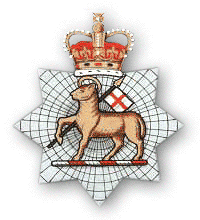
‘…The regimental symbol was a lamb, which somehow seemed too mild to be a symbol for fighting men. As a young rookie expecting fireworks, something fiercer-looking would have suited me better.

‘Old soldiers usually referred to us as “The Mutton Lancers”.’

Private George Coppard, 6th Battalion, Royal West Surrey Regiment

Posted in Soldiers of the Great War, World War I memoirs | Tagged , , , , , , , , , | Leave a comment

HMS Caroline to become floating museum

Image

HMS Caroline, the last surviving British warship of World War I, is to be preserved thanks to and award of £1m from the National Heritage Memorial Fund (NHMF).

This money has been awarded to the National Museum of the Royal Navy (NMRN) which use it to carry out urgent repair works to the Belfast-based light cruiser.

Professor Dominic Tweddle, director general of the NMRN, welcomed the announcement. ‘We cannot overestimate the significance of HMS Caroline. It is the only remaining floating survivor of World War I.

‘NMRN is thrilled that the funding is now in place to secure it and prevent any further deterioration.’

Northern Ireland’s minister for the economy, trade and investment, Arlene Foster added that the funding marks the beginning of a two-stage rescue plan.

She said: ‘The second stage will be driven by a funding application to the Heritage Lottery Fund to restore and preserve HMS Caroline.

‘Our ultimate aim is to transform the ship into a world-class floating museum in time for the Battle of Jutland centenary in 2016, as I believe HMS Caroline has huge potential as a visitor experience.’

Built on Merseyside in 1914, the ship is the last survivor of the Battle of Jutland.

A light cruiser, weighing 3,750 tons and 446ft long, when built she was technologically ground-breaking.

It was her maximum speed of close to 30 knots that enabled the British Navy to respond to the increasing threat of long-range torpedo attack on battleships, locating the enemy fleet and then rapidly carrying news back to the British battleships.

When the war ended she became a static training ship based in Belfast. During World War II, HMS Caroline was back in action, acting as a base for operations to protect the North Atlantic convoys from U-boat attacks.

In 1945 she returned to her role as a static drill ship in Belfast until decommissioned in 2011, making her the longest ship in commission in the British Navy after HMS Victory.

Posted in News | Tagged , , , , , , , , , | Leave a comment

Lieutenant Herman Sim

Lieutenant Herman Alexander Coysgarne Sim

Lieutenant

2nd Battalion, The Cameronians (Scottish Rifles)

Killed in action, 9 May 1915

Age 27.

Buried at Rye-Petillon Cemetery, Fleurbaix, France

Herman Sim was born in Middlesex in 1888. According to the 1911 census he was an undergraduate at Oxford University, living at 19 Holywell St, Oxford.

His parents were Herman Billing Sim and Louisa Henrietta Sim and his father was a banker. Their address in 1921 is listed as 12 Austin Friars, London EC2.

Herman Sim had a younger brother, Lancelot George Earl Sim, who was killed (aged 21) while serving as a second lieutenant in the Grenadier Guards on 14 September 1916. He is buried at the Peronne Road Cemetery, Maricourt, France.

Both brothers are commemorated on their parents’ grave at All Saints Church, Harrow Weald.

Posted in Soldiers of the Great War | Tagged , , , , , , , , | Leave a comment

Major MBH Morgan

South Lancashire RegimentMajor MBH Morgan

South Lancashire Regiment

Died on 22 November 1917

Major Morgan is buried in the cemetery of Llandaff Cathedral in Cardiff next to his father, Sir Morgan Morgan, who was mayor of Cardiff in 1886.

Posted in Soldiers of the Great War | Tagged , , , | Leave a comment

Christmas Truce 1914

Image

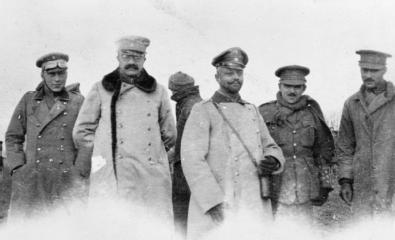
‘All this morning we have been fraternising, singing songs. I have been within a yard in front of their trenches, have spoken to and exchanged greetings with a colonel, staff officers and several company officers. All were very nice and friendly.

‘We have just knocked off for dinner and have arranged to meet again afterwards.’

Captain RJ Armes, Ist Battalion North Staffordshire Regiment.

Captain Armes died on 9 April 1916 in Mesopotamia, while serving with the 7th Battalion, North Staffordshire Regiment.

His name appears on the Basra memorial.

Posted in Events | Tagged , , , , , , , | 2 Comments

Christmas Eve 1914

Image

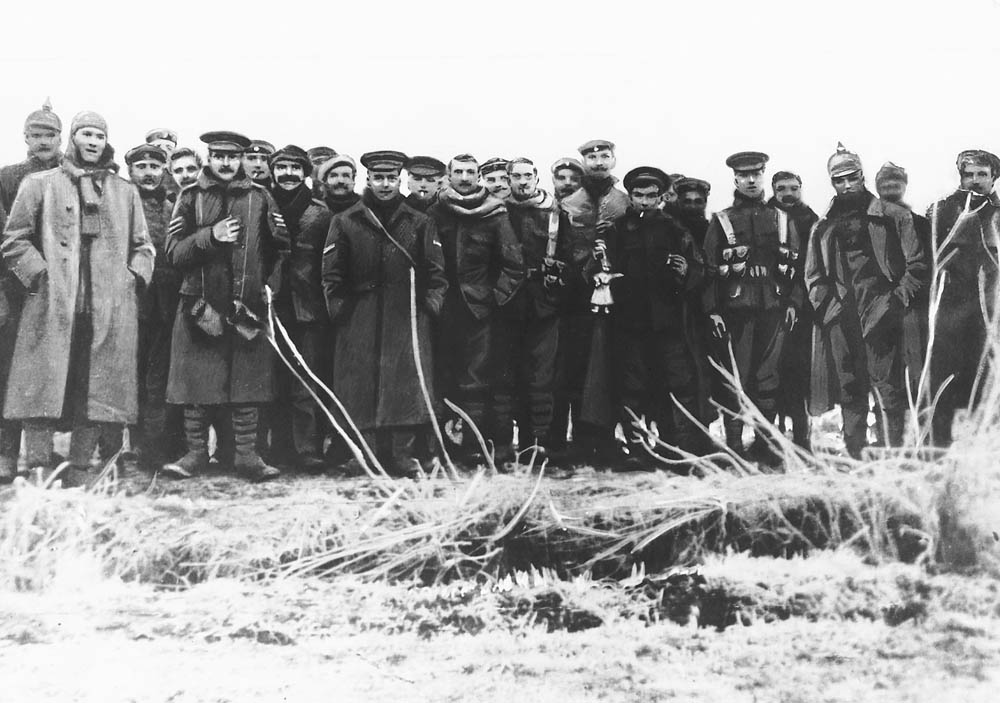
‘On our side they sang Christmas songs in full harmony, then afterwards some national songs. If someone offered a solo, the other side applauded.

‘The French kept as quiet as mice as they listened to the Christmas hymns which no doubt you were singing at home at the same time.’

Private Gotthold von Rohden, 205th Reserve Infantry Regiment.


‘The Saxons… sang one of their national airs to the tune of God Save the King. We replied with the Austrian hymn, at which the applause was terrific. 

‘The music then quietened down and some time was spent yelling facetious remarks across the tenches. 

‘After this some daredevils in E Coy actually went out, met and shook hands with some of the Germans and exchanged cake and biscuits.’

Rifleman PH Jones, Queen’s Westminster Rifles

Posted in Events | Tagged , , , , | Leave a comment

Private Walter Whitehorn, London Regiment

Image

Private Walter Whitehorn

3420

1st/19th Battalion, London Regiment

Killed in action 25 September 1915

Commemorated on the Loos Memorial

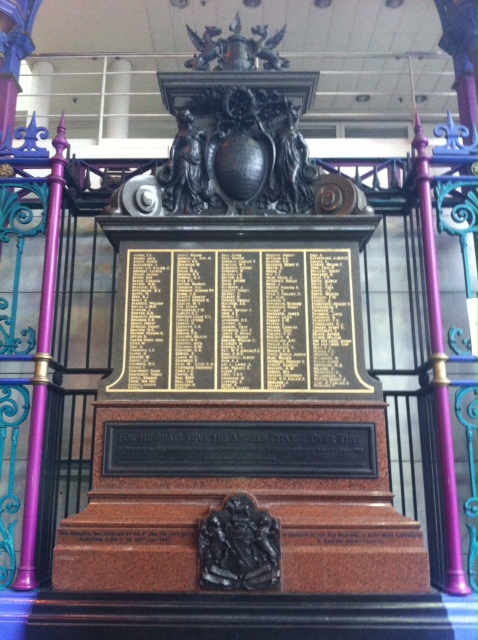
Walter Whitehorn’s name also appears on the memorial at Smithfield Meat Market in London.

On the morning of 25 September 1915, the 1/19th Londons was one of the British units in the first wave of the attack on the right flank of the battle of Loos.

It went over the top at 6.30am and suffered heavy casualties from machine gun fire as it moved towards the village of Loos. Taking the German front line, the battalion then fought off counter-attacks for the remainder of the day.

Some 386 of its men, including 14 officers, became casualties.

Among them was the battalion commander, 37-year-old Lieutenant Colonel Harold Collison-Morley, who is buried at Loos (Dud Corner) Cemetery.

The 1/19th Londons was a territorial army regiment, which had its headquarters at 76 Hight St, Camden Town, London. It had landed in France on 10 March 1915.

Posted in Events | Tagged , , , , , , , | Leave a comment

An American in France

File:Frank_Buckles_recruitment_picture-1

‘What I have a vivid memory of is the French soldiers – being in a small village and going into a local wine shop in the evening.

‘They had very, very little money. But they were having wine and singing the Marseillaise with enthusiasm. And I inquired, “What is the occasion?”

‘They were going back to the front. Can you imagine that?’

Corporal Frank Buckles, US Army.

Buckles was the last US survivor of World War I.

Posted in Soldiers of the Great War, World War I memoirs | Tagged , , , , , | Leave a comment